Topic Clusters: How to Boost Authority and Visibility
The days of creating a single page to target an exact-match keyword are over. As algorithms, AI, and search engines grow in sophistication — and people change the way they search, too — they’re looking for more than just one indicator of quality. Topic clusters that link and structure your content around a related subject are the way forward.
Content clusters allow you to provide multiple pieces of content to position your brand as a subject matter expert and build authority in your specialist field. This enhances your Experience, Expertise, Authoritativeness, and Trustworthiness (E-E-A-T) credentials and improves your website’s search visibility. It’s also an easier way for users to navigate your site’s content.
Building topical authority for your brand helps you rank for more keywords. It also helps in the modern world of AI – allowing you to achieve more large language model (LLMs) citations.
Ready to get started building your topic clusters? Let’s take a look at how and why creating and executing a topic cluster strategy can boost your brand’s authority and drive its SEO performance.
What are topic clusters?
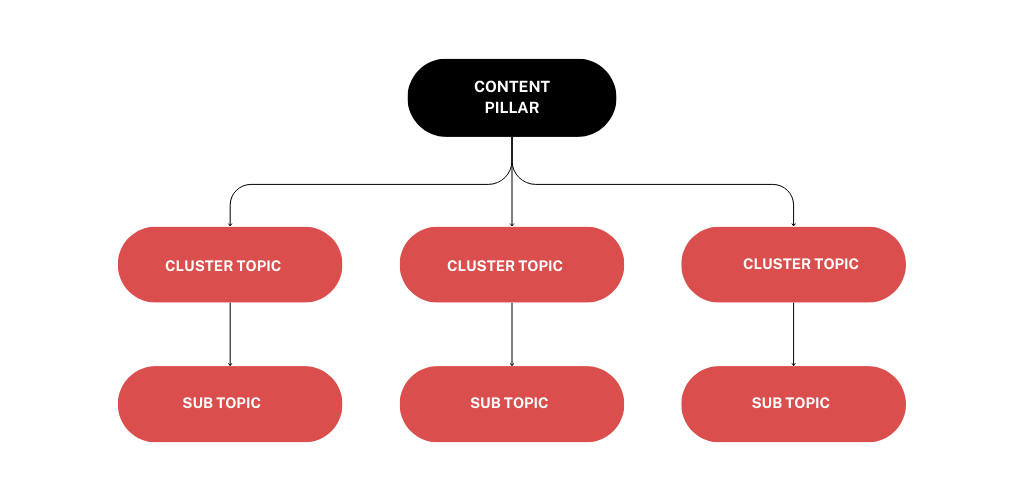
Topic clusters are collections of individual content pieces centred around the same specific theme. Also known as content clusters, they’re interlinked and connected to an in-depth pillar page that ties them all together thematically. Topic clusters serve as supporting content that provides deeper insight into the area the pillar page seeks to own.
Topic cluster content often targets more long-tail keywords with an informational focus, using terms like “How” and “Where,” that help the reader learn more about a topic, service, or product.
Topic cluster strategies have been around for a long time. But like anything else in SEO, they’ve adapted and further developed as search engines continue to evolve. Beyond simply ranking an individual page for a single keyword, they now consider the authority of a brand or website across a complete topic rather than just one page.
The three core elements of an effective topic cluster are:
- A pillar page — covering a broad topic and the central theme.
- Cluster articles — supporting articles that focus on one area of the wider topic in greater detail. These are often guides, explainers, comparisons, and pieces that answer common questions.
- Internal linking — connecting back to the pillar and other cluster pages to improve the site’s internal structure and to move the user journey along.
What is a pillar page?
A pillar page is the foundation of a topic cluster. Pillar content should cover your overall theme in comprehensive detail, generally focused on a broad, high-volume keyword. It’s the parent, and its offshoots are your cluster content, with links that connect them.
Pillar pages aim to rank highly and establish expertise in the niche. However, they shouldn’t cover any one subject too thoroughly. Doing so would deflect from the purpose of the cluster content. So there’s a fine balance to be found. A content pillar builds topical authority that holds monetary and SEO value, as it’s the cornerstone of earning clicks, affiliate commissions, leads, and traffic.
Topic cluster example
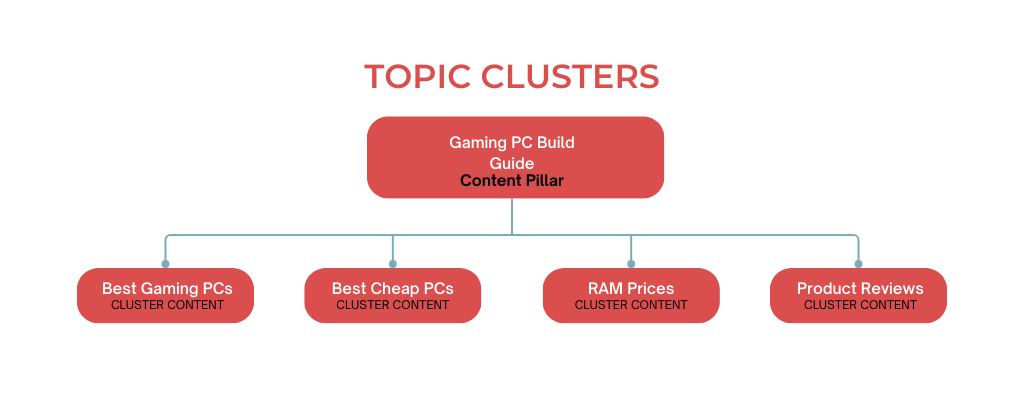
This example from PC Gamer shows how to master a topic cluster model. The magazine’s guide to building a gaming PC comprehensively covers all the different components required. The robust internal linking structure leads the reader to other related detailed posts that users are likely to find beneficial.
Logical subtopics include exploring the importance of RAM speed, the best gaming PCs, and recommending products and product reviews for each part of the build.
Why do topic clusters matter for SEO and AI visibility?
Topic clusters provide relevance and structure for your website content. They add depth in a specific subject area, demonstrating your expertise and authority (two key components of E-E-A-T). Search engines and AI models prioritise high-quality content from trusted and authoritative sources, which is what a topic cluster strategy aims to achieve.
Research shows that content clusters can drive 30% more traffic and maintain rankings for 2.5 times longer, compared to standalone pieces (or isolated keyword SEO). More clicks and lower bounce rates can lead to better user engagement and higher conversion rates, key metrics that signal to search engines and AI tools that the content is useful and valuable to readers.
A content cluster demonstrates deep subject matter knowledge and signals your authority. They cover more related areas around a theme with additional pages focused on specific aspects, which helps your brand answer more queries around the topic.
Good internal linking within a content cluster builds on this by showing how pages relate to each other, which makes it easier for users, search engines, and LLMs to understand the structure of your website.
The main SEO benefits of topic clusters are that they:
- provide more entry points and ranking opportunities to capture search around wider subtopics, increasing clicks and impressions.
- form a logical structure that makes it easier and faster for Google and other search engines to crawl your site and index pages.
- efficiently pass link equity between related pages.
- satisfy E-E-A-T and produce helpful content.
- reduce cannibalisation risks with a clear topic cluster strategy that should avoid duplication.
- create a good user experience by guiding people along their content journey, leading to better bounce rates and increased conversions, which search engines value.
How do topic clusters improve SEO performance?
Topic clusters improve SEO performance in several ways. Firstly, thematically grouping your content helps Google understand it and verify your level of expertise. Topic clusters improve user flow by ensuring your content structure is clean and understandable, which helps Google crawl and index your website faster.
The information on your site must be valuable and match what readers search for. Topic clusters map different search intents. Pages based around the same subject but dedicated to commercial (guides and category pages), informational (blog posts, explainers, and FAQs), and transactional search (product pages) cover different intents to boost visibility across all areas of a theme and show true depth of knowledge and experience.
Interlinking within a topic cluster shows the relationship between content to guide users to other pages that align with their intent. It also helps search engines understand the importance of different pages within the cluster and rank them appropriately.
Content topic clusters expand your reach, allowing you to target long tail keywords alongside high-volume search terms. Rather than just focusing on top-level keywords with high difficulty, this provides opportunities to capture lower volume yet easier ranking opportunities and build a strong foundation for the topic. This, in turn, can help increase organic traffic.
Following a topic cluster strategy also demonstrates more authority compared to a website with only one page covering the subject. This boosts your E-E-A-T, favoured by Google, improving your chances of ranking for relevant terms.
Finally, having a clear structure and hierarchy should also avoid duplicate content and cannibalisation issues that harm SEO performance.
Topic clusters and AI search
Many of the ways topic clusters improve SEO performance also apply to AI search. Pillar pages and content clusters create a clear structure that LLMs can easily understand. This helps AI systems recognise authoritative sources on a topic and pull out and cite relevant information related to user prompts and queries.
Topic cluster architecture aligns with query fan-out. This is a process that ChatGPT, Gemini, Perplexity, Google AI mode, and AI Overviews use to create responses by expanding into sub-questions. Rather than seeking a single answer, AI asks many follow-up questions for thorough coverage, which cluster content supports.
People use different prompts when searching for information about a specific topic, but they can yield similar results when using AI tools. Providing enough relevant, useful, and detailed information with a topic cluster helps deliver better semantic and contextual understanding for both AI and humans.
AI systems can easily map relationships between pages when a site uses a topic cluster strategy. This improves its understanding, assists with intent matching, and improves the chances of more citations, links, and traffic for your site through AI platforms.
How to create effective topic clusters
How you create topic clusters that resonate with your target audience and demonstrate expertise and authority on a subject depends on your industry. Relevance is key, as you should only build clusters around themes you have the necessary level of expertise to talk about.
Follow these steps to create topic clusters that help improve your SEO and AI search performance.
Pick a relevant pillar
Choosing your main topic should be the first decision. It must be relevant for your business and audience, far-reaching, and capable of branching into several sub-content pieces. Aim to strike a chord with your brand and audience by providing value — it could be by offering a solution to a problem or matching keywords your customers are searching for.
Your pillar article should be based on a broad keyword of high/medium difficulty with a high search volume. The supporting topic cluster content needs to be informed by low search volume keywords, including those from questions and long-tail phrases.
Research the topic
Analyse SERP trends on the topic and see what LLMs surface to identify the most relevant and useful content for users. Review the themes and intent behind content that ranks and how competitors organise the structure of their content clusters for inspiration.
Audit your existing content to avoid duplication and cannibalisation. Some pages might be easily optimised and included in the cluster, while others may need removing or repurposing to align with your strategy. Social listening tools and ideations can generate further content ideas.
Map keywords and sub-topics
Keyword research and mapping help expand your cluster and form a logical structure around a specific theme while avoiding duplication and cannibalisation risks. Have a clear focus on keyword difficulty and search volume for your pillar page and supporting content targeting long-tail search. Related keywords and common questions can inform your sub-topics.
Beyond keywords, consider what people want to know next after landing on specific pages you’ve mapped out to continue their journey. Speak to your sales team and find out what common questions or problems customers ask about.
Internally link pillar and cluster pages
Connect separate pages to the pillar content and supporting articles to build a cluster. Strong internal linking with descriptive anchor text helps users, search engines, and AI tools easily locate content and understand the relationships and relevance between them.
Google crawls websites by following links using Googlebot. This bot arrives at your homepage, gathers webpage information, and follows links to crawl its way through your pages. It configures the relationship between pages, blogs, case studies, and other content.
Demonstrating how content relates to other content on your site gives Google and AI models an overview of the structure and enables them to detect similar subject matters across different pages.
The pillar page of a topic cluster should include links to all your subtopic content, with the subtopic pages returning the favour. This process informs Google that your content pages are connected and related. Balancing the link value you place on each page establishes a clear hierarchy on your site, strengthening the overall authority of your content.
Build out cluster content
Start by creating your pillar page first, so you can link everything together logically. This process will also help you avoid unnecessary repetition. Then expand and cover the broad subtopics you’ve outlined.
This isn’t the time to bring out your creative side, as you need to ensure your readership, search engines, and AI tools can easily digest and absorb your content. Write naturally and don’t stuff keywords, as you’ll cover the topic comprehensively.
Create a topic cluster strategy with SALT
Think your site could benefit from an improved structure around its topical organisation to become an authority on the subject? Our content marketing services can help your brand build and execute an effective topic cluster strategy that aims to boost your SEO performance and AI visibility.
Get in touch with SALT to discuss your project today.


