The Infinite Tail: How AI has rewritten the rules of search discovery
For a considerable time, searching online was a relatively straightforward exercise. Users would either rely on a short, memorable phrase, known as the “short tail,” or a significantly longer, highly specific phrase, referred to as the “long tail.”
The long tail was characterised by queries containing three or more words, often reflecting a user’s advanced stage in the buying or research process, such as “best value compact mirrorless camera 2024 reviews.”
The Long Tail concept was first articulated by Chris Anderson in 2004 and later expanded upon in his 2006 book of the same name.
While short-tail terms accounted for the highest search volume, the long tail represented a vast share of web traffic and conversion opportunities. This was due to their high specificity and lower competition.
However, the emergence of AI search has fundamentally transformed this landscape. It has rendered the old rules obsolete and introduced a new way users engage with the internet (and platforms) as a method of discovery, research, and purchasing.
I call this the Infinite Tail.
The defining feature of the Infinite Tail is its representation of an effectively unlimited and unmeasurable query space.
This stands in stark contrast to the short tail and long tail concepts, which were inherently based on a fixed, finite set of text-based keywords or phrases.
The Infinite Tail represents a combinatorial explosion of multimodal and conversational intent, signifying that there are no longer fixed questions.
Breaking up the search bar constraints
In the past, users often felt constrained, attempting to guess the ‘right’ words that would satisfy a search engine.
As a result, the SEO tool ecosystem began to focus on a limited set of conventional keywords, with ranking serving as the core success metric. AI search has eliminated these constraints and removed a lot of “search friction”, allowing people to express their intent in any manner they choose, whether it be typed, spoken, or image-based.
This is facilitated by conversational search, which encourages users to refine their search over multiple steps, much like a natural dialogue, and vernacular search, where people use everyday language rather than technical or constrained keyword phrases to find information. This is important when determining what the dominant, common interpretation of a query is.
This profound shift in user behaviour is underpinned by two key psychological theories.
The first is Information Foraging Theory, which suggests that users behave like hunters, constantly adjusting their queries based on the balance of effort versus reward. AI significantly reduces the effort, or friction, to near zero, encouraging users to experiment with broader and more complex requests.
The second is Cognitive Offloading, where users naturally tend to outsource difficult mental framing tasks. With AI search, they can simply describe their goal and allow the model to interpret and translate it, thereby removing the burden of crafting precise queries.
A practical illustration of the Infinite Tail in action can be seen in travel planning.
Instead of the traditional “Spain holiday November” a user might now ask, “Where should I go in November if I want quiet beaches and direct flights from Manchester?”
Alternatively, they might upload a beach clip from a platform like TikTok and inquire, “Where is this and can I go there for under £X?”
We’re also seeing this in the “education” that Google is pushing in advertising to encourage adoption of AI Mode in the “Search Like Never Before” campaign.

Understanding why users go online in the first place
We can take this a step further. It’s not just about the methodology or the way people search. It’s about understanding and categorising users based on why they go online in the first place. Back in 2024, when I spoke at several events, I shared the idea that there is a clear pattern between the impact of AI-driven search and the user’s underlying purpose. That purpose often aligns closely with the commercial intent behind a query.
With the rise of UCP and ACP and the evolution of agentic commerce protocols, we’re moving closer to a world where AI doesn’t just influence discovery but directly shapes commercial outcomes.
I argued that there are four core user groups:
- Learners
- Participators
- Shoppers
- Purchasers
Each group comes online with a different motivation, and that motivation affects how AI can influence their journey.
Users who want to learn or discover are exposed to a higher level of AI influence. Their journeys are more open-ended, which means AI can guide, shape, and even redirect their path in powerful ways.
Participators may use AI to explore new topics, find discussion spaces, or sense-check what’s being said in forums. However, they are often engaging within spaces they already recognise. Shoppers and purchasers follow a slightly different route. Historically, they would move toward an e-commerce site or another clear transaction point.
Now that agentic commerce is becoming more mainstream, AI agents are increasingly playing a more active role in the transaction layer, which will inevitably shift how and where purchases are made.
This makes the idea of the Infinite Tail even more relevant. In the past, users would stack queries in a relatively linear way, refining their searches step by step until they reached a final destination. Today, that journey is far less predictable. Users move fluidly across platforms, formats, and devices.
They interact with multimodal content, dip in and out over different timeframes, and rarely follow a straight path. The journey is no longer linear. It is distributed, dynamic, and shaped by AI at multiple touchpoints.
Because of this shift, we need to rethink how we approach SEO, including the basics like keyword research. The traditional model relied on a defined set of keywords as the primary measure of success.
Search goes beyond just words
Human thought processes are not limited to keywords. They include images, emotions, goals, and problems. Multimodal search reflects that reality. It allows users to skip complex written descriptions and let the system interpret the details instead. A photo or a screenshot, for example, can communicate intent in seconds.
As new formats like voice and image become more common, the number of possible inputs increases dramatically. The Infinite Tail is not just about more text-based searches. It represents an expansion in the ways people can express what they want and need.
In this new environment, the idea that models generalise sits at the centre of everything. AI search systems now focus on matching meaning rather than matching exact keywords. They rely on semantic understanding instead of string comparison.
This works because semantic embeddings map both web content and user queries into a shared vector space. In that space, the system can measure conceptual similarity, even when the wording is completely different. A page does not need to repeat the exact phrasing of a query to be relevant.
The model can interpret a broader intention, such as “a safe and easy family holiday spot”, and connect it to related concepts like calm beaches or family-friendly restaurants, even if those phrases do not appear in the original query.
This shift in semantic capability is one of the biggest opportunities the Infinite Tail creates.
Content is no longer limited to the exact terms a creator optimised for. It can surface for questions, contexts, and variations the creator never predicted. This expands potential reach and visibility in ways that were not possible under a purely keyword-driven model.
Decisions are multi-step journeys
Search is no longer a one-time action.
People don’t just type a query and click a result. They typically either follow a query-stacked path of asking, reviewing, and continuously adjusting, or as we’re seeing in the case of AI Search and the lack of clicks to websites (which historically informed our attribution metrics), they read, remember, and return (if the messaging synthesised by the AI resonated with them).
In this setting, the Infinite Tail is better understood as all the possible paths a user can take, not just the first keywords they enter.
Two psychological ideas help explain how people act during these multi-step searches:
- Choice Overload: In areas like travel and online shopping, there are often too many options. This can overwhelm users, so they rely on AI to filter choices and simplify decisions.
- Goal-Gradient Effect: As people get closer to making a final decision, their motivation increases. Their questions become more specific and focused. Broad searches turn into detailed “micro-queries” as they move toward a clear goal.
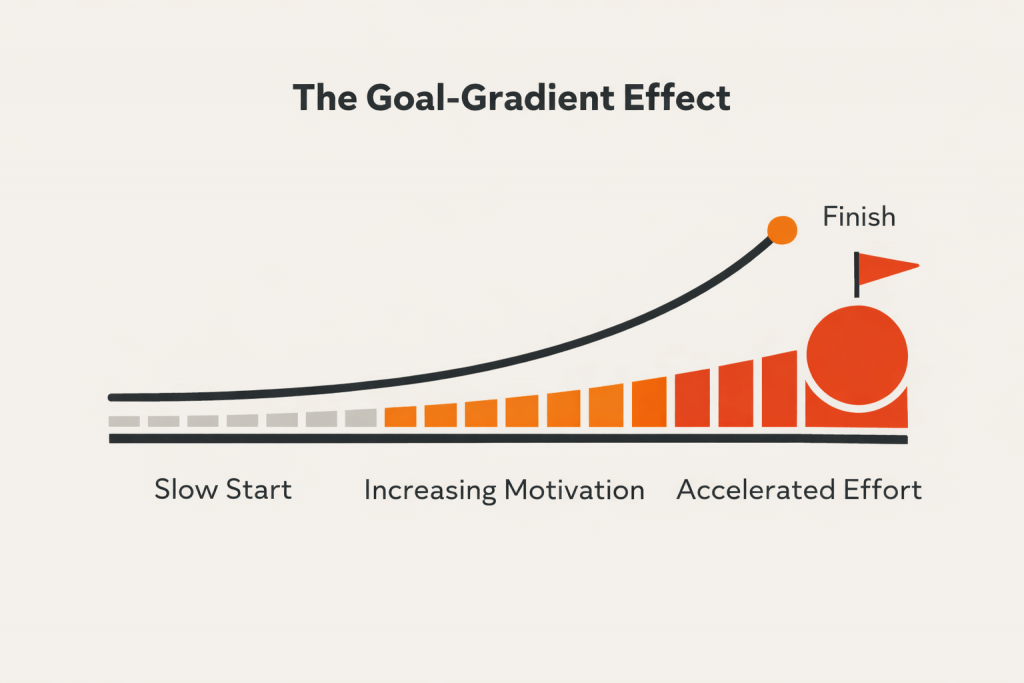
Planning a holiday shows how this works in practice.
The process often unfolds in five stages. It begins with a broad question, such as “Warm places in Europe in April.” Next, the user adds a constraint: “Which is cheapest for a family of four?”
Then comes more detailed filtering: “Show me hotels with pools and restaurants nearby.”
After that, the user might upload a screenshot and ask, “Is this area walkable and safe?” The final step shifts to action: “Plan a five-day itinerary if we stay here.” Each step builds on the last. The system remembers the earlier context, allowing the search to grow into a structured conversation that moves steadily toward a decision.
Is “ranking” now a probability game?
In the Infinite Tail, success is no longer about ranking for a single keyword. It depends on how likely your content is to satisfy clusters of related user needs. Instead of competing for exact phrases, brands compete to meet the broader intent behind many variations of a search.
Probabilistic ranking captures this shift. Search systems estimate the probability that a page will satisfy an inferred intent cluster rather than match a specific keyword. The focus moves from words to user goals and context. A page ranks because it is predicted to be the best fit for that situation.
Users judge the quality of the final answer, not the individual links behind it. Ranking is based on a blend of signals, including semantic relevance, user behaviour, multimodal consistency, and Large Language Model re-ranking. The outcome is a unified response designed to satisfy intent.
For brands, this means the universe of possible queries is too vast to track individually. Success comes from clearly covering real use cases, aligning content and visuals with intent, demonstrating trust, and structuring information so AI systems can interpret it easily.
AI and multimodal search have expanded intent beyond traditional limits. SEO is no longer about targeting a narrow set of phrases. The goal is to become the single best answer across countless micro-intents, gaining visibility for new queries and appearing across more stages of the user journey.
Talk to our team about preparing your search strategy for the Infinite Tail.


