Repurpose, reuse and refresh your content: The value of reworking over creation
Every content marketing team knows the feeling. Keeping the content calendar full of new titles and campaign plans can feel like a full-time job. There’s always another blog, landing page, webinar or social post waiting to be created.
But for CMOs under pressure to prove marketing ROI, the question is no longer how much content your team can produce. It’s where your content budget can generate the greatest return.
With AI search changing how people discover and consume information, simply creating more content isn’t necessarily the most effective route to growth. Before allocating another pound to producing something from scratch, there’s a strong business case for looking at what you already have.
Your existing content represents an investment that has already been made. Some of your most valuable marketing assets may already exist, buried several pages deep in your blog or sitting unnoticed in an old campaign.
The opportunity is to make your existing content work harder, and to treat your content library less like a production line and more like an asset portfolio.
Each piece should earn its place through its contribution to visibility, authority or commercial goals.
Production should be circular, not linear
Content production is naturally future-focused. Teams research emerging topics, identify new customer questions, and respond to changing market trends. New products launch and search behaviour shifts, so there will always be a need for new content.
But it’s not the only tactic you need.
Many content teams fall into a linear process. The content is planned, briefed, created and published. Then what?
It’s essentially abandoned on the site, left to do its thing while several new content pieces come along to push it down the list. Statistics become outdated. Competitors replicate the ideas with stronger resources. Search behaviour changes. Eventually, something that was once an authoritative piece of content no longer aligns with what people need.
That’s a strange way to treat an asset that may have taken weeks of research and creative work to produce.
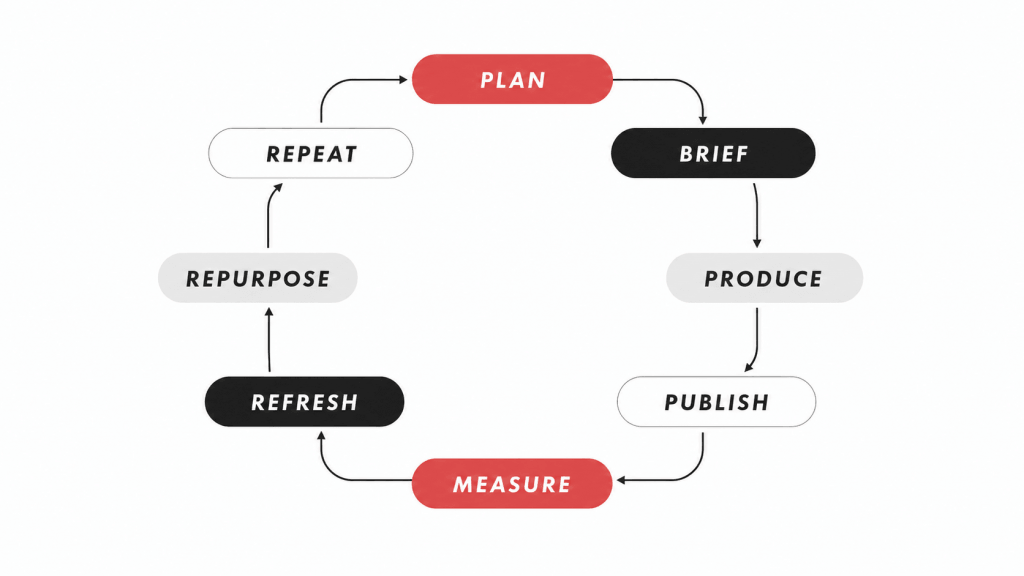
Good content deserves more than a single moment in the SERP spotlight. If you’ve spent significant resources planning, researching, and creating something, it shouldn’t be a one-and-done tick-box activity.
Instead, content production needs to become circular. Monitor what you have, maintain what matters, improve what has potential, and retire what no longer earns its place.
Think about content as an investment
Productivity is often measured by the volume of new content produced. But a new piece isn’t automatically a better investment than improving something that already exists.
If a £2,000 guide requires regular investment to remain accurate and competitive, that maintenance is part of the asset’s cost, not an unexpected extra. Equally, if spending £2,000 improving an existing resource can deliver more value than spending £2,000 creating something new, that should influence where the budget goes.
That requires a proper view of what you already have. Content audits should become a regular part of your marketing workload. They give you visibility of what already exists, what performs well, and what needs your attention. Without that inventory, valuable assets are easily forgotten while your team continues to create new and, potentially, duplicate or overlapping content.
And traffic shouldn’t be the defining metric. A page with modest traffic but strong relevance to a high-value service may deserve more investment than a high-traffic article with little connection to your commercial priorities.
Google Search Console and Google Analytics can help identify pages earning impressions but few clicks, or ranking for valuable terms without delivering the performance you’d expect. These indicators can help you focus your budget on the content with the greatest opportunity for improvement.
The key is to resist treating traffic alone as the deciding metric. A page with modest traffic but strong relevance to a high-value service may deserve more investment than a high-traffic article with little connection to your commercial priorities.
AI search changes the value of existing content
There’s another reason to look closely at your existing content: the search environment has changed.
You might have created genuinely valuable content several years ago, but that content was created for a different search environment, so you can’t necessarily expect it to maintain its performance on its own.
Visibility doesn’t just depend on whether a page contains the right keywords. Content needs to be clear, well-structured and authoritative, while providing useful information that AI systems can understand and use. That makes reworking older content more than an exercise in changing publication dates.
Ask whether the content:
- clearly answers the questions your audience has
- demonstrates genuine expertise and experience
- uses a logical structure and descriptive headings
- contains current examples and evidence
- reflects how the industry now talks about the subject, and
- provides something more useful or distinctive than a generic summary.
This is particularly important when you have accumulated multiple pieces around the same subject. Many established websites contain several short articles covering variations of the same topic. Standing alone and lacking depth, these pages may struggle to perform, while also competing against one another.
Consolidating several weaker pages into one comprehensive resource can create a better experience and concentrate the authority you’ve built in one place.
In an AI search environment, there is a further reason to do this: if your best thinking is scattered across several thin resources, you are making it harder for both people and search systems to understand where your real expertise lies.
The goal is to have stronger, more useful content that demonstrates what your brand knows.
Refreshing your content
A good example here would be SALT’s client, Pickard Properties. As professional letting agents, the details of their location landing pages can change over time. The information covering local transport links and nearby shops for their professional lettings Horsforth page, for example, may have changed since the first page was created. In this case, the page should be reviewed yearly to ensure the stated information is still correct.
Refreshing their content meant keeping it aligned with user expectations and search intent, including:
- Updating statistics and research references
- Replacing broken links
- Adding new content to answer emerging questions
- Refreshing screenshots and visuals
- Expanding explanations with deeper expertise.
Your handy framework for deciding what to do with content
Once you’ve identified the content with the greatest opportunities, the next step is deciding how much resource to allocate to each piece.
A simple way to approach this is to assess every asset against two factors: its existing authority and its strategic value to the business.
| High strategic value | Low strategic value | |
| High authority | Update and strengthen: Preserve the authority you’ve built while improving the content’s quality, relevance, and visibility. | Repurpose or redirect: Consider whether the authority could be put to better use elsewhere, or whether the content can be adapted for another channel or purpose. |
| Low authority | Rewrite and strengthen: If the topic matters to your business, invest in making the content more useful, authoritative, and unique. | Retire: If the content has little authority and little strategic value, don’t spend budget maintaining it. Remove or consolidate it where appropriate. |
This gives content teams a practical way to prioritise their resources. Rather than treating every existing page equally, focus investment where there is both a clear business case and an opportunity to improve performance.
The result should be a deliberate content portfolio, rather than an ever-growing library. Every asset should have a role: protect and strengthen the pieces already delivering value, invest in strategically important content with potential, repurpose what can work harder elsewhere, and retire what no longer earns its place.
Repurposing should make good content work harder
Refreshing isn’t the only option. A substantial content asset usually contains multiple ideas that can be adapted for different audiences, channels and formats. A blog or research piece might become a LinkedIn carousel, a newsletter, a webinar discussion, a downloadable checklist, a podcast talking point or a short video.
But repurposing shouldn’t mean endlessly reproducing the same content because you can. The point is to get more value from a strong idea.
One piece of research, for example, could support a sales enablement asset, an executive LinkedIn campaign, a webinar and several search-focused resources. The original investment stays the same, while the number of useful outputs increases.
That can reinforce your expertise around the topics that matter most to your business, rather than leaving you with dozens of disconnected ideas.
Build a content library, not a conveyor belt
Many organisations instinctively prioritise new content because it feels more measurable, exciting, and visible. Yet some of the highest-return marketing activities happen behind the scenes.
Updating a trusted guide. Consolidating duplicate pages. Improving an established resource. Turning a successful piece of research into something useful for another audience. These activities don’t have the same satisfying feeling as pressing “publish”, but they can be a much better use of your budget when the underlying asset already has value.
The strongest content strategies balance creation with maintenance. New content keeps your brand relevant, while refreshed content protects the authority and investment you’ve already built.
For CMOs, that means moving away from the idea of a content calendar that simply needs to be kept full, and thinking of all your content as assets in a portfolio.
Protect the assets already delivering value. Invest in strategically important content with potential. Make strong ideas work harder across channels. Consolidate where your expertise is scattered. Retire content that no longer earns its place.
AI may have made creating content faster, but it hasn’t made deciding what content deserves to exist any less important to your strategy.
SALT’s team of experienced content strategists can help you identify which content to create and which to update. Reach out to SALT.agency and reinvent your content.


