Understanding & Explaining Query Fan-Out
Not long ago, searching the web felt like using a simple database index. You typed in a keyword and received a list of pages that matched, with different variables and weightings (that we knew as ranking factors). Today, search has become far more sophisticated.
With AI at the core, platforms like ChatGPT, Gemini, Perplexity, and Google’s AI Overviews now rely on a process called Query Fan-Out to not only build responses, but stretch into more of the user journey.
Query Fan-Out is how AI takes a single question and expands it into a network of related sub-questions. Some LLMs give you greater access to this information than others, for example when you prompt in Perplexity you get a window in other searches performed:
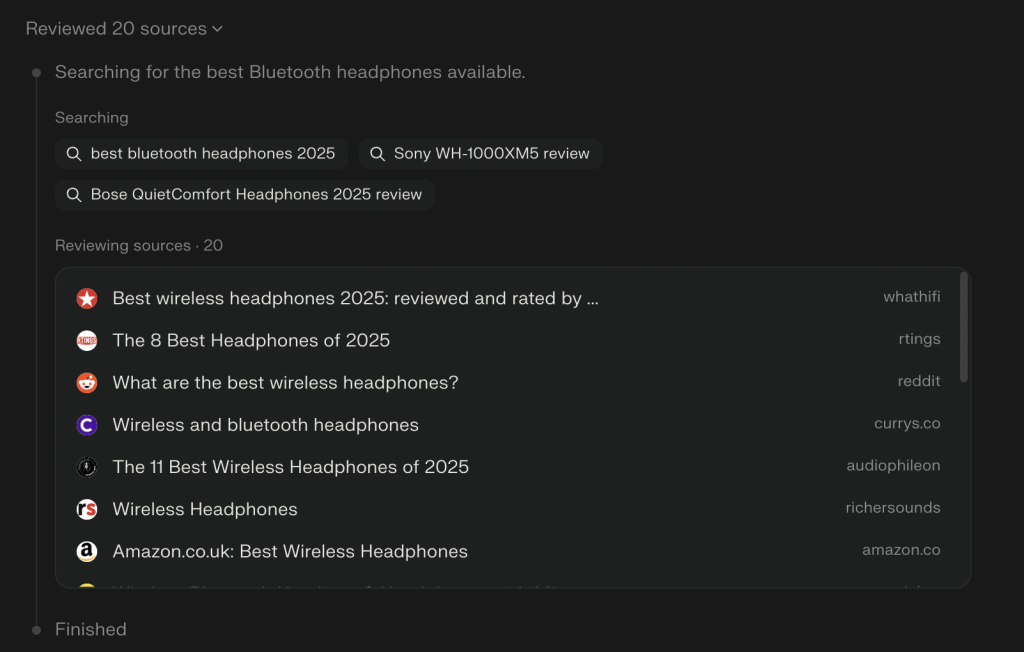
It shapes what content gets surfaced in answers and determines which parts of your website are seen and used. Instead of answering just one query, the system runs dozens at once, each exploring a slightly different angle.
What Decomposition Really Means
To do this, the AI breaks down your original query into smaller parts, this process is called decomposition. Rather than treating your question as one big block, the system splits it into specific, manageable pieces.
Imagine searching for Bluetooth headphones with a comfortable design and long battery life for runners. According to Google AI Mode, it also performed searches for the following terms (this process isn’t reliable, but gives you some insight into what may be going on):
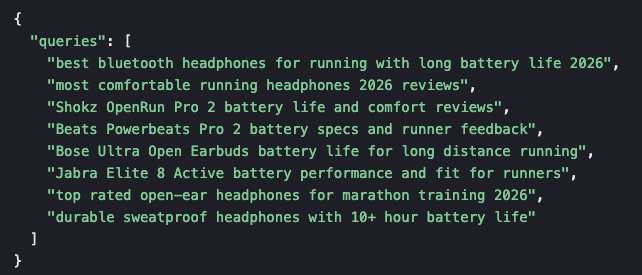
The AI does not look for a single perfect answer.
It asks several follow-up questions to gather what it needs. For example, it might ask what the best-rated Bluetooth headphones are. It also looks for models built for runners, then it searches for battery performance and what users say about comfort.
All of these run at the same time, pulling insights from across the web to build a more complete response.
Content Chemistry and Why It Matters
In this AI-driven world, strong content needs to be more than just readable. It must be made up of clear and useful parts. This idea can be called content chemistry.
Just like elements are built from smaller components, great content is made up of detailed facts that stand on their own.
For your content to show up in AI-generated answers, it needs to be specific and easy to extract. Broad articles with general information are far less helpful. Instead, every paragraph should contain something useful on its own. These should be tied to clear details like product names, locations or services. When the AI runs its expanded search, it scans for facts it can pull directly. If your content is well organised and factual, it is far more likely to be picked up and included.
When AI Misses the Point
Sometimes the system drifts away from what was asked, this is known as semantic drift. It can happen when the AI brings in loosely related content that is not really relevant.
One reason this happens is the gap between what you want right now and what the system thinks you want based on your past searches. For example, if you have searched about marathon training many times before, then suddenly look up low-impact cardio because of an injury, the system may still show you running advice. It is still relying on your past behaviour, missing the fact that your needs have changed.
The Risks of Personalisation and Filter Bubbles
AI search also takes your personal context into account. That includes your location, the time, your role and even your industry. This makes search feel more tailored, but it also creates the risk of a filter bubble. That is when the system keeps showing you similar opinions or information, simply because it is trying to match what you have looked at before.
Personalisation and filter bubbles will only continue to play a larger role, especially within Google’s ecosystem, as it begins to utilise project Mariner to further integrate multiple aspects of your “digital identity” to not only produce information, but seamless agentic experiences.
What Replaces Keyword Targeting
The old method of repeating keywords across your content is no longer enough. AI does not measure success by how many times you mention a phrase or if you adequately match the intent of a small cluster of keywords, or even if you “write FAQs to cover the long tail queries”.
It measures success by whether it includes your content in its reasoning.
That means your goal is to be cited as a source within the AI’s final answer. You need to move away from trying to cover broad topics and focus instead on journey-aware content. This means writing with clear intent for different moments in the user’s decision process. Think about how someone moves from initial research to deciding on a product or installing it after purchase. Your content should support these transitions in a clear and structured way.
Winning in the AI Search Landscape
For marketers and business owners, all of this means older keyword tactics no longer work the way they used to. Visibility now depends on how well your content fits into this new AI-powered approach.
Start by thinking in terms of content chemistry. Make sure each section of content includes a specific fact that can stand alone and be pulled into a response.
Understand how your audience moves through the buying process. Write content that speaks to different stages, from research to decision to action.
Most importantly, focus on being cited. In this new model, success means being mentioned in the AI’s explanation, not just appearing near the top of a search result.


