Understanding AI Training Data
TL;DR
Publishing a webpage before an AI’s stated cutoff date does not guarantee the model actually read or learned that content. Automated collection gaps and strict quality filters eliminate the vast majority of web pages long before training even begins. As a result, web strategies should focus on real-time search visibility rather than assuming older content is permanently stored in an AI’s memory.
We rely on artificial intelligence tools across daily workflows while operating under a widespread assumption regarding AI model knowledge.
Many individuals believe that a webpage published on the web before a training cutoff date enters model memory by default. This assumption creates errors in strategic planning because publication dates fail to guarantee inclusion within dataset architecture.
Four distinct barriers isolate live website content from model weights, transforming the process of dataset creation into a sequence of selection procedures.
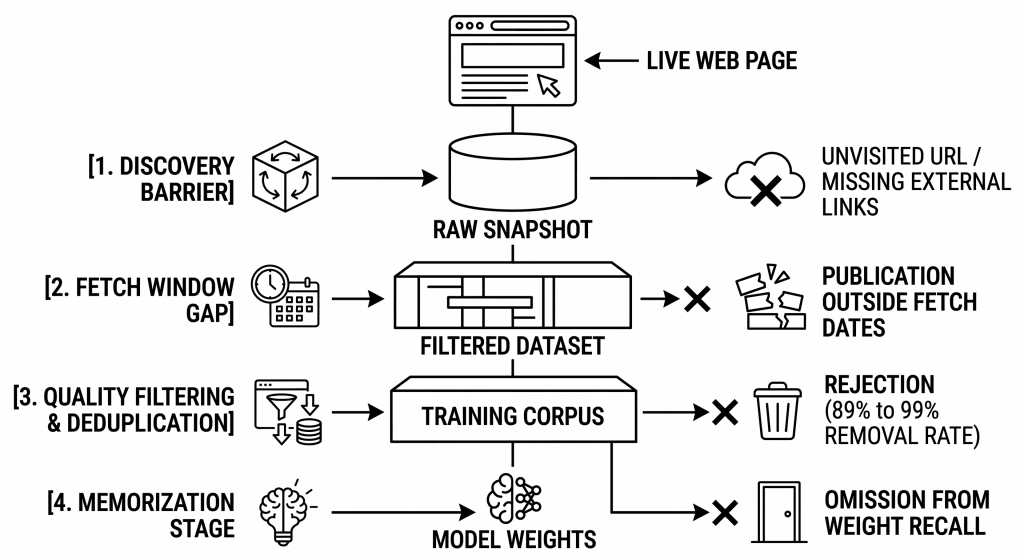
Fetch windows x human assumptions
Models publish cutoff dates to indicate the boundaries of their model knowledge. A model might state a cutoff date of August 2025, which leads marketing teams to assume that the model evaluated every page published up to the final day of that calendar month.
Common Crawl, who are a major provider of training data for pretty much every AI/LLM, operates on short fetch windows that cover specific time windows (e.g., a fortnight) rather than full calendar months.
| Crawl Identifier | Public Month Label |
Real World Fetch Window
|
| CC-MAIN-2025-33 | August 2025 |
2 August 2025 to 15 August 2025
|
| CC-MAIN-2026-04 | January 2026 |
12 January 2026 to 25 January 2026
|
| CC-MAIN-2026-17 | April 2026 |
10 April 2026 to 23 April 2026
|
| CC-MAIN-2026-30 | July 2026 |
10 July 2026 to 23 July 2026
|
Content published on August 16th 2025 would not be included in the August archive run. The content would need to wait for the September fetch cycle, which means that evaluations relying on calendar labels introduce boundary errors of up to two weeks before processing pipelines begin.
A training cutoff is not a capture date, and the gap is wider than the cutoff framing suggests.
A cutoff tells you nothing about which version of a page entered a corpus, and nothing about whether the page entered at all. Four independent filters sit between “live on the site” and “in the training data”.
Presence in a corpus is not recall. A fact appearing once in one surviving document is generally not retrievable from weights. A tool that infers training-data inclusion from a publication date and a cutoff date is guessing at a mixture no lab has published, then formatting the guess as a measurement.
Why crawlers miss live pages
The existence of a live URL on a server doesn’t guarantee crawler discovery during an active fetch window. Crawling algorithms explore the internet by navigating links from established web domains.
A new domain or an isolated page lacks incoming links and broader discovery, which prevents crawlers from discovering the site/new URLs within the limited operational windows.
A webpage can load in a browser, respond with standard server codes, and allow crawler access, but remain absent from public web collections.
Data pipeline filtering
Raw web captures contain vast quantities of unstructured text that dataset builders refuse to ingest into neural networks.
Models process archives (of webpages) through automated filtering pipelines designed to eliminate low-quality documents and structural noise. Open-source research projects such as FineWeb and RefinedWeb demonstrate that quality filtering pipelines remove between 89% and 99% in every 100 captured webpages/documents.
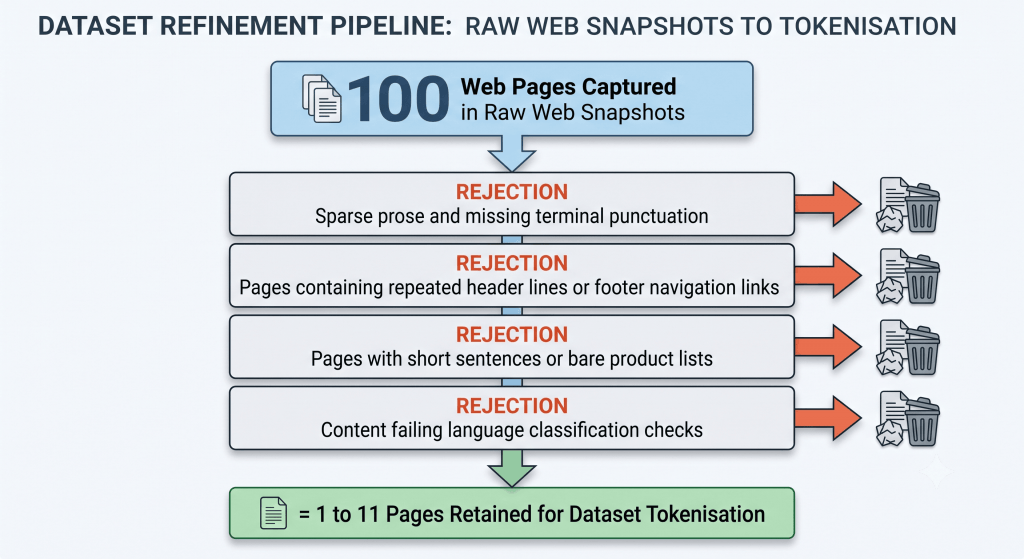
Authenticity indicators
Curation pipelines apply scoring mechanisms to assess document value, discarding structural noise while retaining high-value prose. Content achieving lower penalty scores exhibits key authenticity indicators that protect documents from automated filtering rejection:
- Specific examples, data points, and named sources: Detailed references and verifiable data points demonstrate concrete subject coverage that separates authoritative articles from generic boilerplate text.
- Personal experience and clearly held opinions: Direct observations and distinct authorial perspectives provide unique information signals that automated quality filters prioritise during ingestion runs.
- Distinctive voice and sentence rhythm: Natural variations in sentence length and individual writing styles pass syntactic complexity checks designed to eliminate repetitive generation patterns.
- Counterintuitive or surprising arguments: Original logical structures and unexpected insights signal original thought, which helps documents pass qualitative evaluation thresholds.
- Evidence of expertise: Accurate usage of technical terminology within context proves deep domain familiarity, satisfying language model domain-matching criteria.
- Titles that are specific, creative, or make a clear promise: Heading structures that state explicit focus areas help classifiers map document content to relevant category buckets without triggering generic title “penalties”.
Webpages incorporating these authenticity indicators achieve lower rejection scores, which improves survival rates across pipeline processing stages.
Data deduplication
The expectation is that deduplication systems reduce the multiple “snapshots” of a single URL, into a single master file. But research by dataset creators show a different method across AI/LLM training pipelines.
Deduplication systems operate within individual snapshot cycles rather than across multi-year archives. Algorithms such as MinHash remove duplicate content within a single monthly fetch window, which alters outcomes for content creators:
Repetition (increases representation) as a stable webpage captured across twelve distinct monthly crawls can pass into the training corpus twelve times, increasing its token frequency and raising the probability of weight retention.
Intra-snapshot filters remain strict within a single fetch window, deduplication algorithms eliminate up to 94% of redundant data, removing low-quality variations and template copies.
The three states of web material
A content or SEO content strategies need understanding and to accommodate the distinction between three conditions, that describe how artificial intelligence systems encounter web content.
- Crawled: A web crawler fetched the page HTML and saved the raw bytes into a public archive library.
- Trained: The document passed quality filters and entered model memory as permanent knowledge parameters.
- Retrieved: A live web search mechanism accesses current page content at query time to answer user requests.
An automated crawler visits a website address, downloads the raw web page code, and stores that snapshot inside a digital archive library.
Storing a copy inside an archive proves that a machine downloaded the page, though archive storage guarantees nothing about whether an artificial intelligence model reads or learns the text.
The document then passes quality filters and enters the mathematical memory of the artificial intelligence model during training runs.
Information absorbed into model parameters becomes part of internal background understanding, though vast dataset sizes mean specific facts can fade into background parameters unless repeated across multiple independent sources.
The retrieved material can then refer to a live web search, at the exact moment a user asks a question, reading fresh web pages to craft an answer. Live search retrieval operates independently from pre-training memory, allowing brand content to appear in user answers even if the material missed historical training datasets.
A webpage can exist inside model memory while remaining uncited during user queries because live search routines select alternative sources. A webpage published minutes prior can appear in answers through live web search mechanisms, proving that training presence and search visibility remain separate operations.
How we use this information
SEOs and agency teams can refine operational strategies by adopting core practices that focus on clear outcomes that benefit clients, ensuring budgets and resources are being allocated towards tactics that provide long-term sustainability and growth, and not quick-win, high-risk tactics.
With this information we can:
- Avoid claiming that a model knows a page based on publication dates, choosing precise descriptions that detail capture counts and content stability.
- Improve content so that each document features continuous prose, specific data points, clear authorial opinions, and domain expertise to lower filtering penalty scores during curation runs.
- Ensure that strategy focuses on real-time retrieval engines that process live web data, securing brand presence regardless of training cutoffs.


