DuckDuckGo SEO: Is it worth your time?
You’ve probably heard of DuckDuckGo, a privacy-first search engine that doesn’t track user behaviour or store personal data, as it continues to grow in prominence.
Unlike Google, which uses search history, personal data, and behavioural signals to tailor search results to individual users, DuckDuckGo delivers the same results to everyone based purely on the query itself, prioritising relevance over personalisation.
This key distinction means SEO for DuckDuckGo works a little differently to others in the search landscape.
So, is it worth your time to optimise for a platform that doesn’t rely on personalisation, and where should it sit within your broader SEO strategy as it starts to become more popular?
When brands chase SERP rankings, DuckDuckGo rarely sits at the top of the priority list – but writing it off entirely could be a mistake. While its audience is much smaller than Google’s, it’s also less competitive, and increasingly aligned with modern search trends.
In this guide, we’ll explore how DuckDuckGo works, whether it’s worth targeting, and how to approach SEO for a search engine that stands out from competitors through its non-personalised approach.

How popular is DuckDuckGo?
DuckDuckGo currently holds a relatively small share of the global search market, sitting at 0.76%.
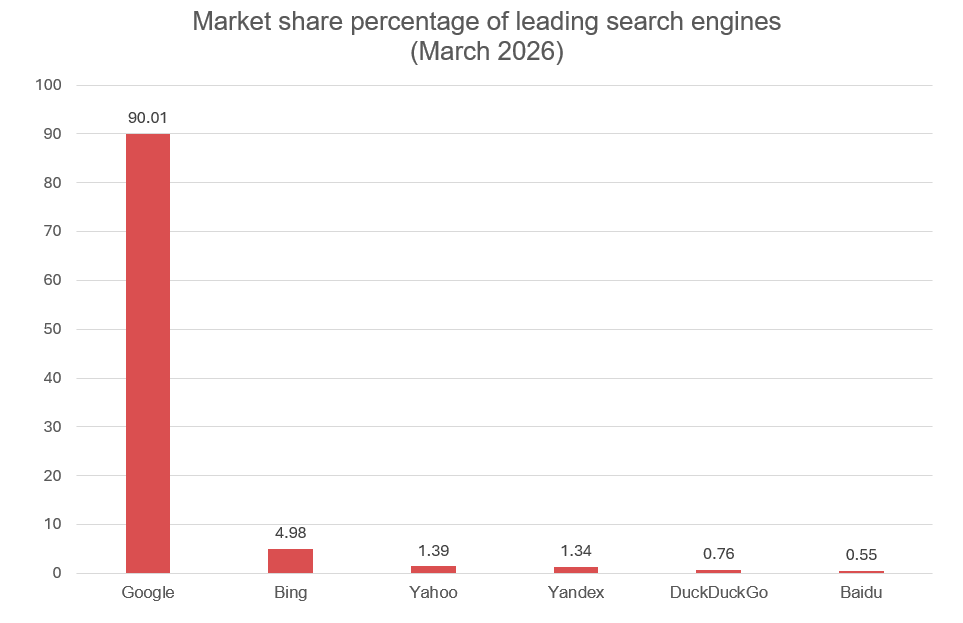
This places it well below Google and Bing, which boast market shares of 90% and 5%, respectively.
On the surface, that makes DuckDuckGo seem easy to dismiss. However, market share alone doesn’t tell the full story.
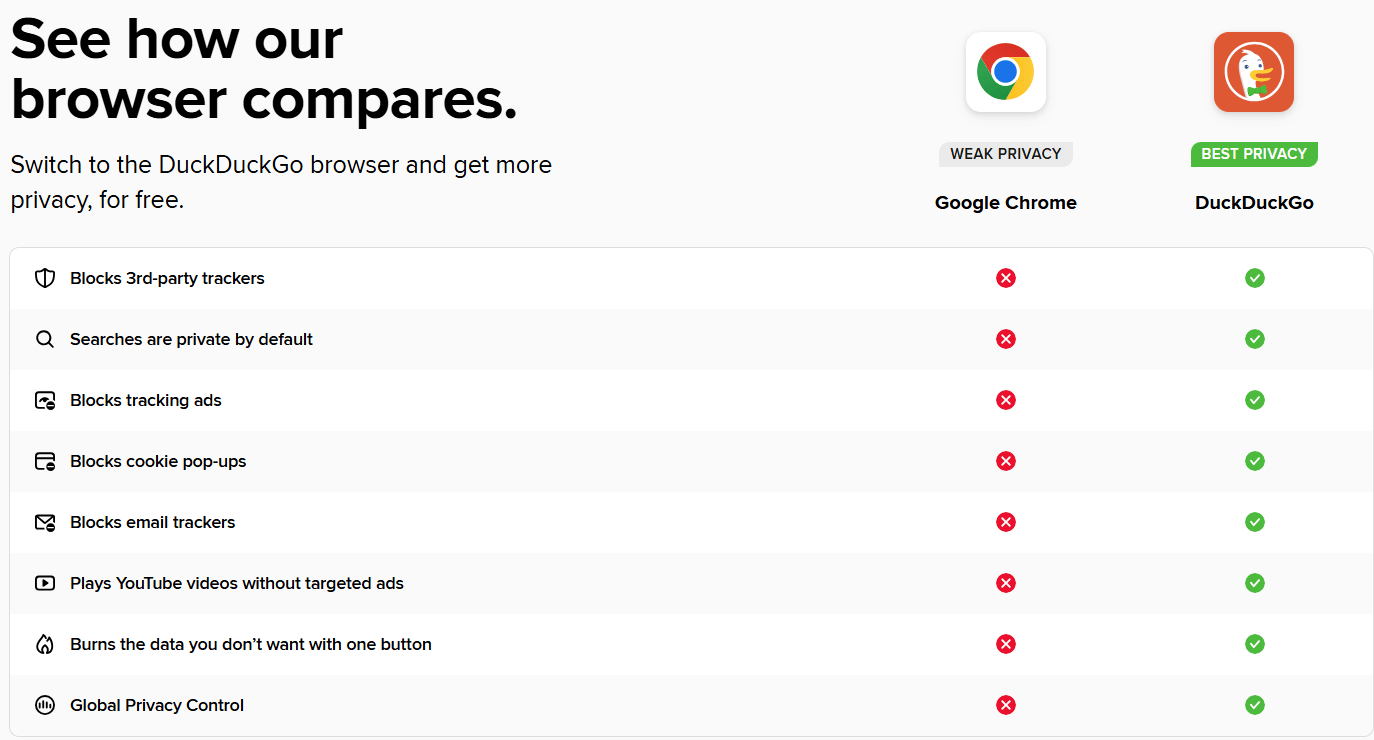
High-value user base
An average of three billion searches are performed on DuckDuckGo every month, with tens of millions of users trusting the privacy-focused search engine globally.
Due to its anti-tracking ethos, DuckDuckGo users tend to be security-conscious and tech-savvy. This makes it a popular choice in high-value sectors where trust and privacy are particularly important, such as finance, healthcare, and legal.
Clicks from DuckDuckGo searches also average a longer time on page and lower bounce rates than competing platforms. The result is a smaller but potentially higher-quality audience segment, depending on your industry.
Influence on Google
DuckDuckGo’s privacy-first approach hasn’t gone unnoticed by larger players. In recent years, Google has rolled out a range of privacy-focused features, including:
- Expanded Incognito functionality across Search, Maps, and YouTube
- Auto-delete settings for search and location history
- A Privacy Dashboard to give users more control over their data.
These features don’t fundamentally change how Google operates, but they do signal a broader industry response to growing privacy concerns. In that sense, DuckDuckGo’s approach isn’t just an alternative, it’s also influencing how search as a whole is evolving.
How DuckDuckGo works
DuckDuckGo aggregates results from a wide range of sources. These include its own web crawler, DuckDuckBot, as well as Bing’s index and a variety of crowd-sourced platforms such as Tripadvisor and Wikipedia.
Crucially, it never uses search history, personal profiles, or behavioural signals tied to individual users. Instead, rankings are driven by how relevant a page is to the query, alongside signals such as authority and backlinks.
The search experience also includes features like Instant Answers, which surface quick responses at the top of the results page.

Another unique DuckDuckGo feature is !bang commands, which allow users to jump directly to searches on other platforms. For example, typing “!yt” before a query will take users straight to YouTube search results, bypassing traditional SERPs altogether.
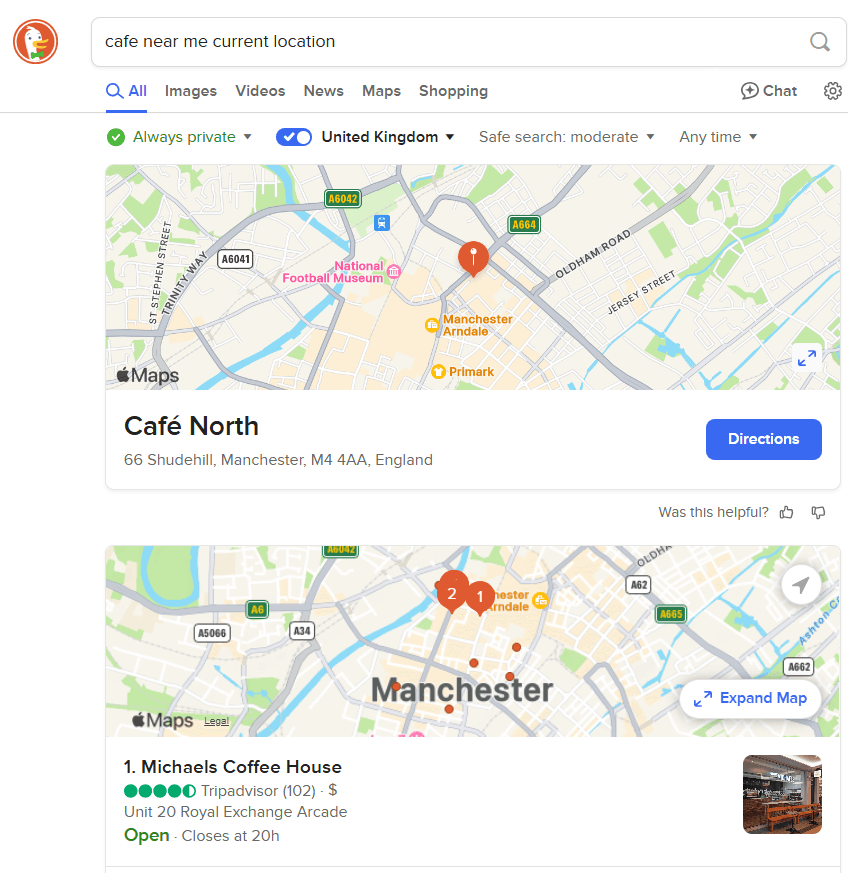
DuckDuckGo also delivers localised search results, but to preserve user privacy, this is handled through approximate IP-based signals and sometimes lacks the precision of GPS tracking.
Should you optimise for DuckDuckGo SEO?
DuckDuckGo is still a niche search engine compared to the likes of Google and Bing, but it’s also a signal of where search as a whole is heading, and the growing divide between privacy and personalisation. Here’s the case for including DuckDuckGo in your SEO strategy.
Query-led rankings over personalisation
Rather than relying on user data to shape results, DuckDuckGo ranks content based on the query itself. That means visibility is driven more by what you publish than who is searching, which creates a more level playing field and puts the emphasis on strong SEO fundamentals.
Lower competition
Optimising for DuckDuckGo creates an opportunity to capture demand that competitors may be ignoring. Because many brands don’t actively consider DuckDuckGo, there’s often less competition for certain queries.
Reducing reliance on Google
Google is the most popular search engine by far, but relying solely on it is becoming increasingly risky. If your site is optimised only for Google, one algorithm update or SERP change could tank your rankings at the drop of a hat. Alternative platforms like DuckDuckGo offer a way to diversify and build resilience into your search strategy.
The impact of AI-driven search
Another key consideration is the growing influence of AI-driven discovery. As search shifts towards aggregated answers and away from individual listings, click-through rates are declining. This is particularly evident on Google, where 60% of searches no longer result in a click.
DuckDuckGo offers a partial hedge against some of the risks of the growing AI influence on search. Its results feature AI-generated summaries less prominently than Google and focus more on directing users to external sites, while still rewarding the same signals that underpin AI visibility, such as authority, clarity, and structured information.
Top tips for DuckDuckGo SEO: How to optimise
Rather than treating DuckDuckGo optimisation as a completely separate approach, think of it as an extension of good SEO practice.
Optimising for DuckDuckGo should really be more about strengthening your overall SEO strategy than chasing a new channel. Let’s break down the key elements you need to get right to rank highly on DuckDuckGo.
Prioritise evergreen content
Success on DuckDuckGo starts with content. Because results aren’t personalised, your content needs to work for anyone who searches for relevant queries. This often means prioritising evergreen content that’s universally appropriate for a wide audience, rather than tailoring it to more niche segments.
Get this right, and the results can really pay off. In the example below, results from lesser-known health blogs are ranked above industry leaders like Holland & Barrett for the query “how to make matcha”.

Target strong backlinks
Backlinks are one of the fundamentals of good SEO, and they play a particularly important role on DuckDuckGo. This is because DuckDuckGo has explicitly stated in their help documents that links from high-quality sites are a key ranking factor.
DuckDuckGo’s reliance on multiple data sources means your presence across the wider web plays a bigger role than you might expect. Maintaining consistent and accurate information across trusted platforms, such as directories, review sites, and industry resources, helps reinforce your authority and credibility. These signals can influence how your site is perceived and ranked.
Building a strong and credible link profile remains as essential as ever. If your site is trusted by other reputable sources, it’s more likely to be surfaced in results on DuckDuckGo (and beyond).
Fine-tune your technical SEO
Technical performance is another key tenet of SEO, and it’s as important as ever on DuckDuckGo. Since DuckDuckGo relies heavily on external indexes, technical SEO issues can limit visibility just as much as they would on other search engines. That means your site still needs to be crawlable, fast, and easy to navigate.
Optimise for Bing
It may sound counterintuitive, but one of the most effective ways to improve visibility on DuckDuckGo is actually by optimising for Bing. DuckDuckGo pulls heavily from Bing’s index, so ensuring your site is properly indexed and performs well on Bing can have a direct impact.
Quick wins here include:
- Submitting your site to Bing Webmaster Tools
- Fixing any indexing issues in Bing
- Double-checking your site follows Bing’s SEO best practices.
Make the most of structured data
Adding schema markup helps search engines, including DuckDuckGo, better understand your content.
For Google, this increases the likelihood of appearing in SERP features. Likewise, on DuckDuckGo, good schema improves your site’s chances of featuring more prominently in search results, as well as earning placements in its Instant Answers section.
In this example, the schema for a BBC Food recipe is clearly displayed under its search result in DuckDuckGo, showing the recipe’s:
- User rating
- Category
- Cuisine

Make your local SEO clear
Local SEO works slightly differently on DuckDuckGo. Because of its privacy focus, location signals are often less precise than on other search engines. So if you want to be found, it’s important to make your location explicit within your content.
If your business operates in several locations, creating dedicated location pages or regional modifiers can help ensure you appear for relevant searches.
Consider custom !bang opportunities
DuckDuckGo also offers more niche opportunities, such as submitting a custom !bang command for your site. This won’t directly influence your rankings, but it can make it easier for users to access your site and increase direct traffic, particularly if you have strong brand recognition.
Can you track performance on DuckDuckGo?
Tracking performance on DuckDuckGo is less straightforward than on Google, as it doesn’t offer its own analytics platform, search console, or site submission features.
In practice, this means relying on a combination of tools and indirect signals. You can use GA4 to identify traffic from DuckDuckGo by filtering sources, allowing you to monitor engagement and conversions from your DuckDuckGo audience.
Because DuckDuckGo sources a significant portion of its results from Bing, Bing Webmaster Tools can provide useful supporting insights. While it won’t show DuckDuckGo performance directly, it can help you understand how your site is crawled, indexed, and ranked in a way that often carries over into DuckDuckGo visibility.
On a broader level, it’s often more useful to look at your site’s overall search performance rather than isolating DuckDuckGo entirely. Growth in non-Google traffic, improved resilience during Google updates, and steady organic performance can all indicate that your strategy is working.
Does DuckDuckGo include AI search features?
DuckDuckGo now includes two AI search features, but privacy remains a priority.
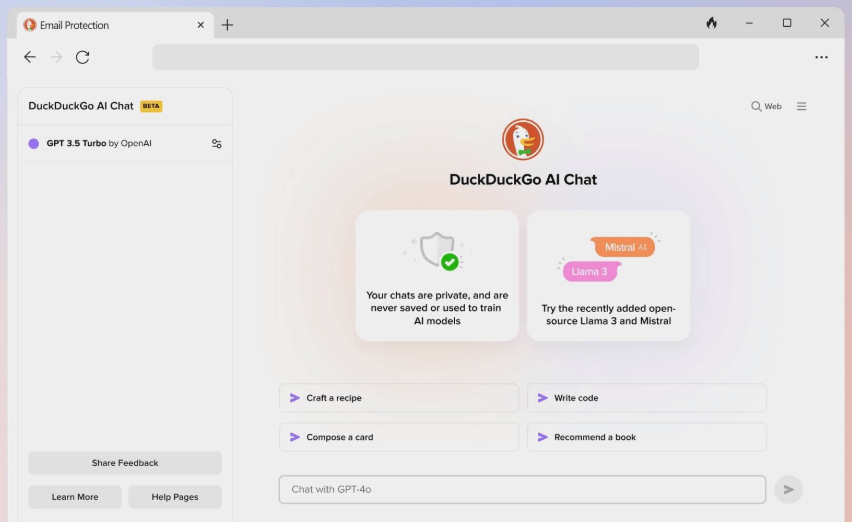
One new addition is a privacy-focused AI chat experience called duck.ai. This allows users to access popular AI models such as ChatGPT and Claude without their conversations being recorded or used to train the AI.
There’s also Search Assist, which anonymously generates answers to search queries by scanning the web for relevant content and using AI to generate a brief answer.
These features are deliberately designed to be private and optional, as DuckDuckGo doesn’t track how users interact with them or use their data for training. Users can also turn AI features off or adjust how prominently they appear.
DuckDuckGo has stated its intention is to adopt a more measured approach to AI in search, prioritising user control and trust while aiming to deliver faster, high-quality answers.
SEO for DuckDuckGo: Top tips and key takeaways
Optimising for DuckDuckGo is worthwhile, but not as a standalone priority within your search strategy. Here are some of the most important considerations to keep in mind when incorporating DuckDuckGo as part of your SEO strategy:
- Build on strong foundations: Optimising for DuckDuckGo works best as an extension of strong overall SEO fundamentals. If you’re already investing in high-quality content, technical performance, and authority building, much of the work is already done.
- Diversification matters: The main advantage of DuckDuckGo optimisation is diversification, reducing your reliance on Google and building resilience against algorithm changes.
- High-quality audience: DuckDuckGo’s smaller audience is still highly valuable, and often more privacy-conscious, high-intent, and engaged than the average search user.
- Relevance over personalisation: Visibility on DuckDuckGo is driven by relevance and authority rather than personalisation. This reinforces the importance of clear, well-structured content and strong backlinks.
- Bing influence: Optimising for Bing directly influences how your content is surfaced on DuckDuckGo.
- Wider web presence: A consistent presence across the wider web, including trusted third-party platforms, can further strengthen your DuckDuckGo visibility.
Let SALT.agency help shape your SEO strategy
Navigating a search landscape that’s becoming less predictable and more fragmented isn’t easy, especially as platforms like Google, Bing, and DuckDuckGo continue to evolve.
At SALT.agency, we help brands build winning SEO strategies across multiple channels. If you’re looking to strengthen your visibility beyond just Google, get in touch with our expert team.


