What Personal Intelligence means for organic marketers and executive leadership
Google’s Personal Intelligence is Google’s next step in turning search and AI into something more like a private assistant than a public information tool. Instead of only answering based on what is available on the open web, it can personalise answers using your own Google data, as long as you choose to connect it.
At a basic level, this changes what “search” means. Traditional organic search is built on the idea that lots of people ask similar questions, and Google ranks the best public pages to satisfy that demand. Personal Intelligence shifts part of the journey into a different lane, where the best answer may not be a webpage at all, and where the “right” answer depends on who is asking, what they have booked, what they have done before, and what Google already knows about their context.
How personalised AI changes traditional search
For organic marketing, the immediate takeaway is uncomfortable but clear. Visibility is no longer just about being the best public answer for a keyword. It is about being present in the ecosystems that shape personalised recommendations, and building the kind of brand signals that survive when the assistant summarises the journey before the click even happens. When AI can shortcut research and compress decision-making into a few lines of text, you can lose demand without ever “losing rankings” in the traditional sense. This will impact the greater majority of websites, at a domain and/or subfolder level.
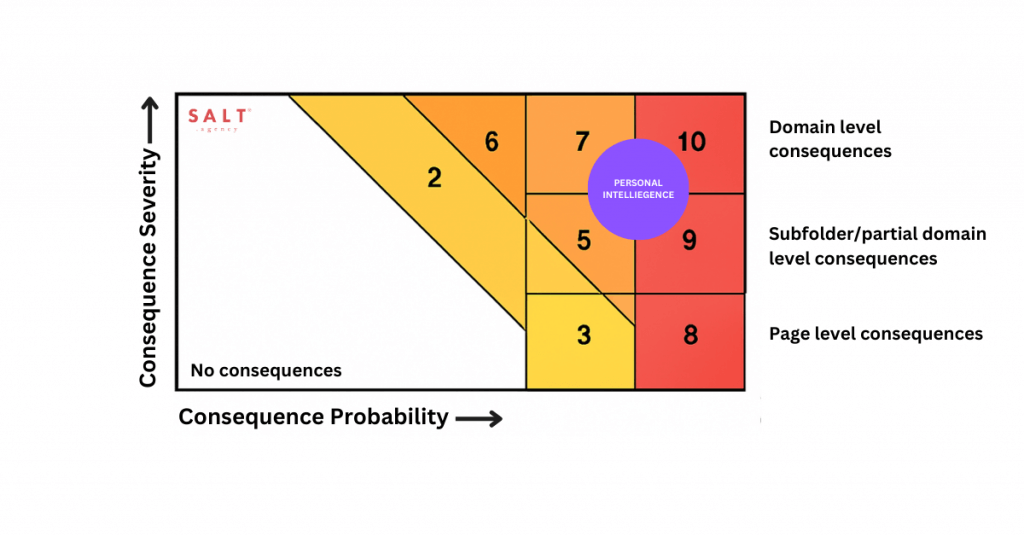
This also pushes marketing further into the realm of trust, recall, and preference. In a personalised world, two people can ask what looks like the same question and get different answers because their contexts are different. That means your performance will vary by audience quality, loyalty, and prior exposure, not just by how good your content is on the day it is crawled. Your brand presence becomes less like a billboard in a search results page and more like a reputation that is carried forward across sessions, devices, and channels.
Why AI search is now a board-level issue
Executive leadership should treat this as a board-level shift, because it affects every funnel stage. At the top of the funnel, AI answers can reduce discovery clicks, but still influence preference and shortlist inclusion. In the middle of the funnel, AI can compare options, filter choices, and recommend a “best fit” brand based on the user’s needs and history.
At the bottom of the funnel, AI can reinforce a decision by validating the choice with summaries and supporting details, potentially pulling in trusted sources like reviews, policies, and brand-owned FAQs. If you only measure success as sessions from non-brand keywords, you will miss the real impact.
The leadership questions to ask now are practical.
- First, are we building assets that AI systems can confidently use, quote, and summarise across the whole customer journey. That includes clear product and service explanations, transparent pricing and policies, strong FAQs, helpful comparisons, and proof that you actually deliver what you claim.
- Second, do we have a measurable strategy for brand demand, not just demand capture.
- Third, are we investing in authority signals outside our own site, such as review ecosystems, creator coverage, partnerships, and digital PR, because these become the supporting evidence that AI can lean on when it recommends one brand over another.
You should also ask what data you are using to steer the strategy. If your dashboards are still centred on rankings and clicks alone, you are optimising for yesterday’s system.
The right view blends traditional organic performance with indicators of AI influence. That can include changes in branded search, direct traffic, returning users, assisted conversions, and shifts in conversion rate that suggest users are arriving more informed than before. In other words, if AI is doing the persuasion earlier, the click you do get can be worth more, but it can also be harder to attribute to a specific touchpoint.
This is where owning your audience becomes non-negotiable. If the future includes more personalised answers inside Google’s ecosystem, then relying on rented distribution becomes riskier.
Email lists, newsletter subscribers, app users, community members, and social followers give you a direct line to customers that cannot be removed by an interface change. They also create repeat brand exposure, which strengthens recall, preference, and trust, which are exactly the factors that matter when the assistant is deciding what to recommend. Your website still matters, but your audience is what makes your website resilient.
Collaboration with other channels also becomes a competitive advantage, not a nice-to-have. Social content builds familiarity and proof of expertise. Email builds repeat touchpoints and lets you educate customers over time. Digital PR earns third-party validation and authority. Partnerships put your brand in trusted environments you do not own.
Even offline activity can strengthen online demand when it creates memorable experiences and prompts branded search later. The key point is that organic marketing is no longer a single channel, it is the connective tissue between your brand, your content, your reputation, and the places customers spend attention.
The future of SEO in a personalised AI world
Finally, leadership should prepare for a world where Google is not only ranking content, but shaping outcomes through personal context. If your strategy is built on generic messaging aimed at anonymous users, you will struggle.
The winners will be brands that understand real customer intent, build helpful assets across the journey, earn trust signals that AI can reuse, and invest in audience growth so they are not dependent on one discovery mechanism.
Personal Intelligence is not the end of SEO, but it is a reminder that the job is changing. Traditional search visibility gets you included, modern AI ecosystems get you considered, and brand strength gets you chosen.
Need to stay ahead of rapid shifts in AI search with a unified approach to GEO and AI SEO optimisation that strengthens visibility, relevance, and performance? Get in touch.


