How do we tackle AI Mode becoming the default Search experience?
Search is shifting from lists of links to answers, conversations and multimodal guidance. At Google I/O in May 2026, Google said AI Overviews now reach more than 2.5 billion people a month and AI Mode more than 1 billion, with AI Mode queries more than doubling every quarter since launch.
Google says it still sends “billions of clicks” to websites every day, but independent studies show click-through rates falling sharply wherever AI answers appear.
I’ve talked about this blended experience before as the multimodal future of search:
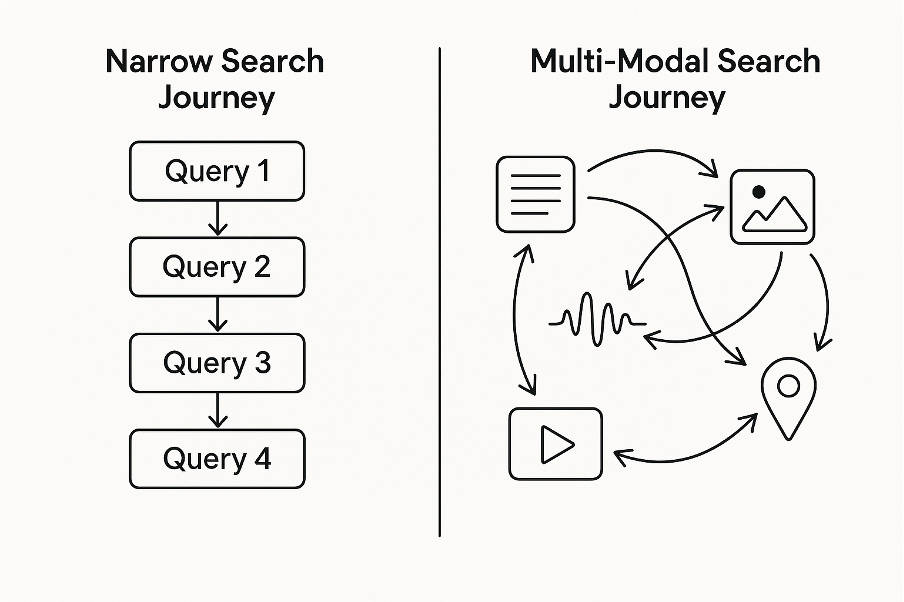
This article looks at what’s changing, what it means for brands, and how enterprises can respond.
How Google Search is changing
Google’s AI Mode and related features (AI Overviews, Search Live and Lens) let users refine their searches naturally, ask follow-up questions, and combine text, images and live camera input. This moves discovery upstream and compresses steps that used to take multiple queries and clicks.
Visual and shoppable by default
AI Mode increasingly supports visual exploration and product discovery, generating rich result sets that feel like a headless storefront layered on top of the open web.
Rollout and prevalence are rising
AI Mode went from a US-only launch in May 2025 to more than 1 billion monthly users a year later, helped by its expansion to more than 200 countries and territories in October 2025. At I/O 2026, Google also began merging AI Mode and AI Overviews into one continuous experience, so users can move from an AI Overview straight into a follow-up conversation in AI Mode without losing context.
Guardrails and inconsistency persist
Google sometimes disables AI summaries on sensitive topics — a reminder that safety and policy boundaries are still evolving, and that brands need to monitor them.
Regulation is now shaping the experience too. In June 2026, after the UK’s Competition and Markets Authority imposed a conduct requirement on Google, Search Console gained a setting that lets sites opt out of AI Overviews and AI Mode without affecting their standard rankings. That control has since rolled out worldwide.
User behaviour and the new demand landscape
For simple information needs, traditional search engines still lead. For complex tasks, AI chat and AI search are gaining share, especially among younger users.
AI is now part of everyday work, too. In February 2026, half of US employees told Gallup they use AI at work in some capacity, up from 21% when Gallup first asked in 2023.
AI usage is mainstreaming
Outside work, Google’s own Gemini app passed 900 million monthly users by May 2026, more than double the 400 million it had a year earlier. Marketers should now treat AI-assisted journeys as the norm, not the exception.
The traffic picture is still contested. Google says total organic click volume has been relatively stable and that AI is sending higher-quality clicks. But independent data keeps pointing the other way. Ahrefs found that by December 2025, an AI Overview cut the click-through rate of the top-ranking page by 58% on average (up from 34.5% in its previous study) and reduced clicks right down page one. We’ve also looked at whether users really show higher intent when they click through from AI.
Treat Google’s figures and third-party studies as channel-specific evidence, not a single average. The overall trend is clear, though: reach inside AI answers is growing fast, while clicks from them are shrinking. That’s why the rest of this guide focuses on being cited and remembered, not just clicked.
Strategic implications for brands
Here are the four shifts that matter most for brands when it comes to the increasing prevalence of AI search.
Answering is the new ranking
Pages built for precise, well-sourced answers are easier for AI Mode and AI Overviews to summarise with attribution. If your page can’t be safely summarised with citations, you risk being left out or losing attribution. So structure your content to produce precise, citeable answers, then monitor whether it’s included rather than assuming it will be.
Entity clarity beats term density
In Google AI Mode and AI Overviews, inclusion and attribution improve when entities and relationships are unambiguous. Invest in first-party entity graphs, schema, author and organisation identity, and consistent naming, then check your citation patterns. Our guide to entity SEO for AI search has more info on this.
Multi-modal readiness matters
With AI Mode, Search Live and Lens, images and video (and their metadata) can be the first touchpoint. Treat visual assets as structured data: authoritative captions, EXIF data where appropriate, and product attributes in alt text and surrounding copy.
Own the journey, not just the click
Expect fewer blue-link visits on informational queries, and shift KPIs towards assisted outcomes such as brand recall, shortlist inclusion, direct navigation and logged-in engagement. Prove value beyond SERP click-through with media mix modelling or geo-holdout tests aimed at those AI-assisted outcomes, so finance teams can see AI Mode as a measurable channel of influence.
Possible scenarios for the next 12–18 months
Here’s how things could look across the next year and beyond. The baseline scenario is largely already playing out, and regulation has started to shape the restricted one. But all three are still worth planning for.
Probable baseline scenario
As AI Mode becomes the default way people search in more regions, AI Overviews will appear on a larger share of informational and some navigational searches. Visual and voice interactions will keep growing. The result is a shift in traffic patterns, where the winners are those with clear, well-cited, valuable content that provides direct answers.
Optimistic scenario for content publishers
Google’s emphasis on “highlighting the web” could lead to more citations and more clicks from AI surfaces, especially for authoritative sources and commerce partners that supply structured, verifiable data.
Restricted scenario based on legal constraints
More topics could be excluded or down-weighted for AI summaries, and visibility could fluctuate for sensitive categories as the compliance burden grows. That would make search results even more fragmented, and YMYL (“your money or your life”) queries harder to optimise for.
The enterprise playbook
Enterprises can’t treat AI Mode as a marginal SEO issue. It reshapes discovery, evaluation and conversion at scale.
This playbook is a structured response to help large organisations adapt quickly, protect their visibility and capture new forms of demand. It has four pillars: content readiness, measurement, demand protection and governance.
Each pillar reflects the reality that AI systems now sit between your audience and your brand, filtering, summarising and shaping perception.
Make your content “AI-ready”
Start with the content itself, so AI systems can extract it, attribute it and trust it:
- Design for summarisation: Standardise problem → approach → constraints → outcome → sources blocks in pages so AI can extract safe, precise snippets with citations.
- Fortify entity signals: Use organisation, product and how-to schema (and medical where applicable), clear authorship, canonical naming and consistent IDs across your CMS, PIM and DAM. Then measure whether those pages earn more citations in AI Mode and AI Overviews, rather than assuming a one-to-one lift.
- Publish evidence, not just claims: Add methods, datasets, FAQs and expert quotes with clear sources to make your content more credible to cite.
- Feed visual search: Provide crisp product imagery, step-by-step photos, diagrams and short clips with strong metadata.
Replatform measurement
Next, update how you measure success. Clicks alone will under-report your AI visibility, so:
- Track AI surface exposure: Search Console’s generative AI performance reports, now available worldwide, show how often your pages appear in AI Overviews and AI Mode, by page, country and date. They don’t show clicks, so pair them with rank trackers, panel research and on-site brand search lifts.
- Adopt assisted-outcome KPIs: Include shortlist ads, sample requests, configurator starts and return visits, then calibrate with media mix modelling or geo-holdouts.
- Develop attribution models that account for AI touchpoints: Move beyond last-click analysis to include the journey stages where AI summaries influenced awareness or preference.
- Build cross-functional dashboards: Give marketing, analytics and finance teams a single view of AI-driven impressions, click-through impact and downstream conversions.
Protect and grow brand visibility
Then protect the demand you already have, and build more of it:
- Shift informational top-of-funnel content to owned channels: Guides, calculators, and tools that build first-party audiences (newsletters, communities, trials) hedge against thinner organic click-through.
- Strengthen product feed and merchant data: For shoppable AI experiences, prioritise complete, up-to-date feeds, attributes, and reviews to qualify for richer placements.
- Invest in brand queries: Brand and navigational demand is less exposed to AI Overview cannibalisation, so build it through PR, creators, and category leadership content.
- Build loyalty ecosystems: Encourage logged-in use, loyalty programmes, and exclusive content that capture audiences beyond the first AI-driven discovery.
- Test direct demand accelerators: Use influencer partnerships, co-branded campaigns, and offline-to-online activity that builds brand recall independently of AI intermediaries.
Governance for a moving target
Finally, put governance in place, because the rules keep changing:
- Create an “AI surfaces council”: SEO, product, data, legal and brand teams meet monthly to review visibility shifts, policy changes, hallucination risks, and experiment results.
- Run red-team reviews: Stress-test your content for mis-summaries on sensitive topics, and define takedown and escalation routes in line with Google’s evolving guardrails.
- Establish escalation protocols: Define rapid-response processes for when AI summaries misrepresent or omit your brand.
- Integrate risk management: Make AI visibility and policy monitoring part of your enterprise risk framework, with board-level oversight.
- Make a deliberate opt-out decision: Review your AI impression data before deciding whether to use Search Console’s AI opt-out, and revisit the decision as your data and the rules change.
- Train teams continuously: Make sure editorial, analytics and PR teams understand how AI surfaces work and which content practices improve inclusion and accuracy.
What “good” looks like in 90 days
Turning strategy into action needs tangible milestones. Treat the next 90 days as an opportunity to set baselines, put AI-ready practices in place and validate new ways of measuring what success looks like.
Here are the practical steps enterprises can take now to prepare for AI Mode becoming the default search experience:
- Inventory and baseline: Map your top 500 queries and pages for AI Overview presence, citation presence (Search Console’s AI reports now help here), and differences in click-through compared with results without AI Overviews.
- AI-ready templates: Ship page templates with evidence blocks, FAQs, structured data and visual assets — but test them, as our research found that templates alone don’t reliably improve citation.
- Visual discovery pack: For your top product and problem pages, add Lens-friendly imagery and short clips with descriptive text and attributes.
- Measurement setup: Create assisted-outcome dashboards and a lightweight MMM or geo-test to quantify non-click value.
- Policy monitors: Set up automated alerts for when AI summaries are switched on or off for sensitive topics in your sector.
Board-level takeaways
At board level, the conversation about AI Mode needs to be practical and forward-looking, not buried in technical detail. Here are the plain truths:
- This isn’t just “SEO with extra steps”: Think of it as designing experiences that machines can understand and safely retell to users.
- You’ll probably see fewer clicks on informational queries: That doesn’t mean you’ve lost. Success comes from being cited, remembered and trusted.
- Multimodal is not optional: People will discover brands through voice, camera, and shoppable visuals, so treat those assets as core brand touchpoints.
- Don’t rely on last-click metrics alone: Google says AI brings quality traffic, but independent studies show steep falls in click-through. The smart move is to test, measure influence earlier in the journey and broaden how you judge ROI.
If you’re building an enterprise AI search programme, our AI search optimisation team can help.


