Are businesses losing real leads to agentic AI?
For a few weeks, our sales and marketing team had a nagging feeling that some website enquiries weren’t making it through, but we couldn’t put a finger on it. There was a lead someone half-remembered, a name that turned up in one system, but not the other. So we kept an eye on it.
Then, on 19 November, we finally caught one in the act.
Two companies filled in the contact form on our website that evening, about five hours apart. One was in our sales CRM 24 seconds later. The other never arrived. Our marketing platform recorded both, yet our sales team just saw one. We only know about the second because someone noticed it the next morning and added it by hand, 17 hours late.
I have a working hypothesis about why, and I think it applies to far more businesses than ours. The anti-spam layers we put on contact forms were built for a web where anything automated was a bot. That web is gone. Real buyers now arrive with browsers that autofill, password managers that guess, and AI agents that fill in forms for them. To a spam filter, some of those look exactly like a bot.
I’m publishing this now, while it’s still a hypothesis, so other businesses know what might be happening on their own forms. We’re collecting more data, and I’ll follow up once we know whether this is something every business needs to act on. All prospect names have been removed.
One form, two leads, one missing
Our setup is common, which is why it matters. A form on the website collects the enquiry, and several layers of spam protection check it. When the website accepts the entry, an automation platform creates the contact and a deal in our sales CRM.
Our marketing platform watches the same form from a different angle. Its tracking script runs in the visitor’s browser and records a submission the moment someone clicks submit, before the website’s own checks have run.
That difference is the whole story; the marketing platform sees the click, the sales CRM only sees what the website accepted. One is a witness, the other a destination, and nobody was comparing them.
Here’s what the two records showed for 19 November:
- A US cybersecurity training company submitted at around 9 pm. The automation ran, and the lead was in our sales CRM 24 seconds later.
- A UK software company submitted at around 4 pm. It had a company email address and a clear brief: a website and SEO audit with a prioritised list of recommendations. The marketing platform recorded it under the same form name. The automation never ran. It reached the sales CRM at 9 am the next morning, typed in by hand, with the surname misspelt.
- A life sciences consultancy submitted the next morning and was in the sales CRM in 14 seconds.
In the same window, every obvious bot submission reached the marketing platform, and none reached sales. So the filters were working, just on the wrong person, too.
If the automation never ran, the website never accepted the entry. Something between the click and the database said no to a genuine buyer.
How a contact form decides who is human
A genuine enquiry has to pass three checks before anyone in sales sees it, and any one of them can drop it without telling anybody.
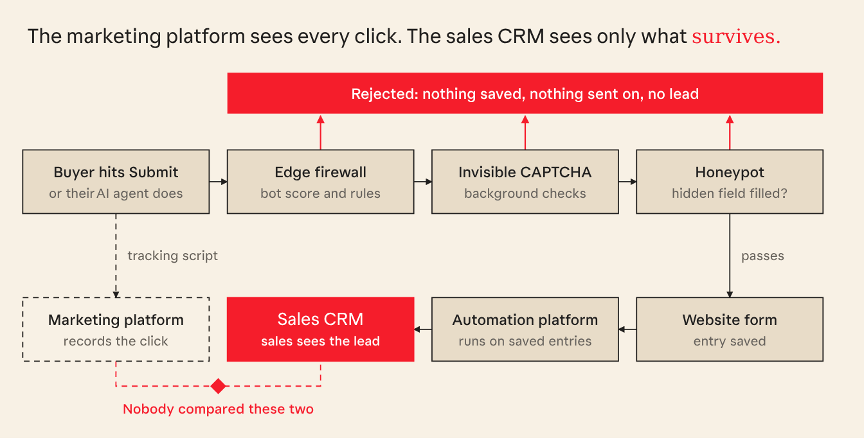
Our contact form has three checks between the click and the sales pipeline:
- The edge firewall scores the request before it reaches the website. Firewall rules, bot scores and managed challenges all run here.
- An invisible CAPTCHA runs background checks in the browser and hands the form a token. No token, no submission.
- The honeypot is a field people can’t see. A person leaves it blank. A script that fills in every field doesn’t. If it has a value, the submission is treated as spam.
Most form tools give you two choices when a check fails: throw the submission away, or keep it in a spam folder. Either way, nothing is passed on to the next system. So a false positive is silent by design. The only record of it is the one the marketing platform made in the browser before any check ran.
Why real buyers now look like bots
Every honeypot assumes that a person never fills in a field they can’t see. That’s still true. The problem is that more and more often, the person isn’t the one filling in the form.
Three kinds of help now sit between a buyer and your form, and each can trip the honeypot:
- Browser autofill. This one isn’t new. In 2018, Ubuntu’s single sign-on found that Chrome’s password manager was filling a hidden honeypot field with the username, locking real users out. The bug came back in Chrome 75. Firefox 94 did the same thing. The maintainers of one popular honeypot library reported a jump in false positives, almost all from Chrome, to the point where they were catching more humans than bots.
- Password managers. 1Password, LastPass, Bitwarden and Proton Pass have all been reported to fill hidden honeypot fields. Each one handles it differently, and most honeypots aren’t built with any of them in mind.
- AI agents. This is the new part, and the part I think is growing fastest. Perplexity Comet, Claude in Chrome and Gemini in Chrome can fill in a form for the user. They run inside the visitor’s own Chrome, so the site can’t tell them apart from the person. They read the page’s structure, not its pixels. To a model reading the code, a hidden input with a plausible name looks like a field worth filling. Agents that run in the cloud have the opposite problem: invisible CAPTCHAs score browser behaviour and device fingerprints, which is exactly where an automated browser looks least human.
The infrastructure layer is moving the same way. Since 15 September, Cloudflare blocks its “Agent” category by default on pages that show ads, for new domains. Most B2B sites don’t show ads, so it won’t apply to them. But it shows the default assumption at the edge of the web: an agent is something to stop.
Put those together, and you get a problem nobody designed. A buyer asks their assistant to “get a quote from these three agencies”. The assistant does it properly, fills in every field it can find, and walks straight into the trap we built for spam bots.
To be clear, this is a hypothesis. We haven’t caught an agent in the act on our own site. What we have is a pattern in the data that fits it, and no good alternative explanation yet.
What the numbers say so far
One missing lead is an anecdote, so I went back through every submission our marketing platform recorded from the contact form since 1 August. I matched each email address against the sales CRM.
Roughly half of all submissions were bot spam, with random strings for names and messages. Another 9% were vendor pitches: link building, guest posts and the like. The rest, just over 40%, looked like real people. I removed an internal test and one contact who had been in the sales CRM for years. What’s left is every genuine enquiry since August.
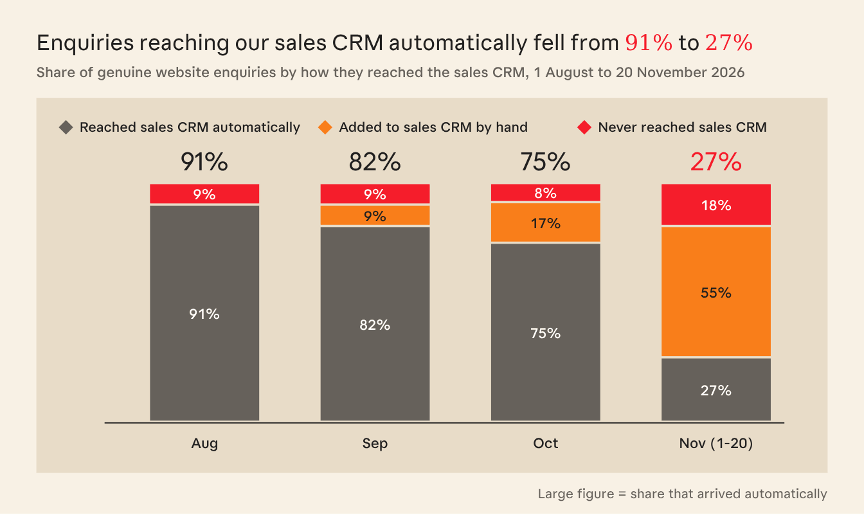
Across the whole period:
- 69% of genuine enquiries reached the sales CRM automatically
- 20% had to be added by hand
- 11% never arrived.
The trend matters more than the average. From August to October, the automation missed between 9% and 25% of enquiries each month. In the first 20 days of November, it missed 73%.
The leads rescued by hand include a property developer planning a site migration, a company looking for a new SEO agency, a fintech CMO, and the software company from 19 November. These are exactly the enquiries an agency wants. The ones that never arrived were mostly lower value: job enquiries, a prospect outside our market, a small-business enquiry, and one from a domain that imitates a well-known brand’s.
Speed matters too, because a lead that arrives late is worth less than one that arrives on time. When the automation worked, the lead was in the sales CRM within 5 to 24 seconds. When a person had to rescue it, the median delay was 15.5 hours. The slowest took almost five days.
Where this leaves us
We haven’t pinned it down yet. The pattern is clear enough to worry us, but not clear enough to name a single cause. It could be AI agents. It could be autofill or password managers. It could be something on our side we haven’t spotted. Whatever it turns out to be, real buyers are filling in our form and not reaching our sales.
In the meantime, nothing goes missing silently. Every genuine-looking enquiry is now cross-checked, and sales hears about anyone who doesn’t arrive.
That’s the flag I want to raise. If you rely on a contact form, compare what your analytics or marketing platform recorded with what actually reached your sales team. It takes an afternoon. If the two don’t match, you’re not alone, and it’s better to find out now than after your next good lead disappears.
There’s an irony here that isn’t lost on us. At SALT, our job is to make brands irresistible to machines and unmissable for their people. Our own contact form may have been doing the opposite: so good at resisting machines that it stopped hearing from the people behind them. Have we become too good at what we set out to do?
We’ll keep watching, and I’ll share what we find once we know more.
The web spent 20 years learning to keep machines out of our forms. Our buyers may now be sending machines in on their behalf.


