Entity Strength Index (ESI), the new standard for brand authority
Brands that lack a recognised Knowledge Graph entity risk being treated as ambiguous strings of text rather than established corporate entities, rendering them increasingly invisible in an ecosystem driven by direct answers.
The Entity Strength Index serves as a modern successor to PageRank by offering an analytical framework designed to measure how clearly defined, widely recognised, and deeply trusted a corporate identity remains across AI infrastructure.
What is ESI?
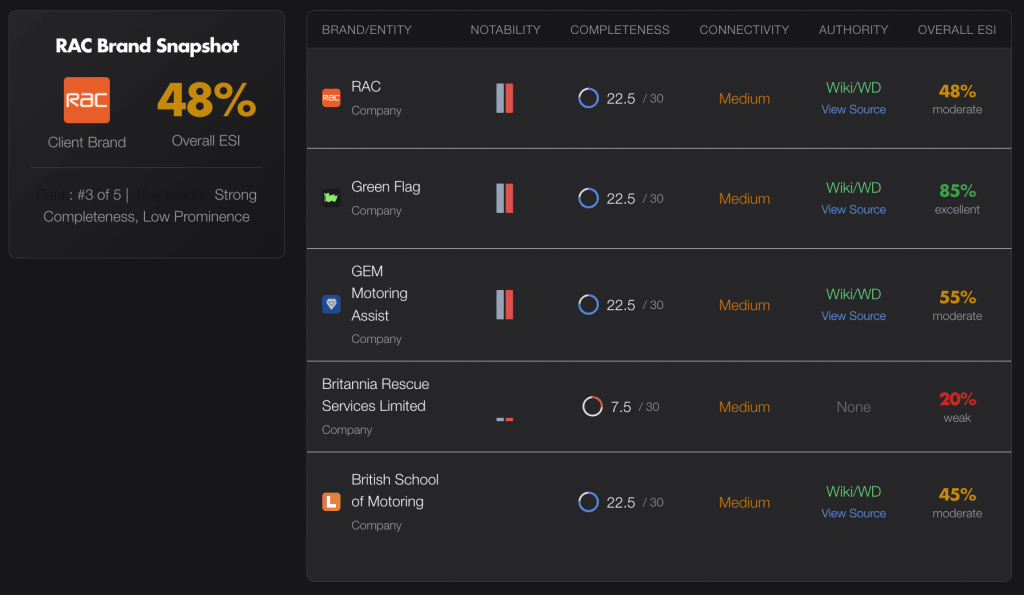
ESI measures the structural clarity and overall authority of a brand within artificial intelligence knowledge systems to determine whether automated platforms trust and recommend a company over its marketplace competitors.
For non-technical stakeholders, the index operates like a digital reputation score by evaluating whether AI models comprehend your business as a distinct concept, such as Apple Inc., rather than confusing it with a generic term.
The index evaluates entity strength across four key areas:
- Relative Notability – evaluates how widely recognised a brand is as a distinct entity rather than a generic keyword across authoritative digital platforms.
- Metadata Maturity – assesses data completeness and accuracy to ensure AI systems rely on structured facts through Schema rather than unverified guesswork.
- Connectivity – examines digital associations and co-occurrence to measure how frequently a brand appears alongside established industry leaders.
- Canonical Authority – determines whether AI models recognise a brand’s primary digital properties as the single authoritative source of truth for its industry sector.
Why brands need to pay attention to ESI
Adapting to the entity economy has become essential for long-term commercial survival because online search habits continue moving away from traditional link discovery. More than half of all web queries now conclude without a single click because AI summaries, knowledge panels, and voice-assisted devices deliver immediate answers sourced exclusively from the top canonical entity in a given category.
Brands with low ESI scores are completely excluded from these single-answer environments.
A robust ESI profile provides a stabilising layer of verified facts that actively protects corporate reputation by preventing AI models from generating hallucinated details or spreading unverified assumptions when data gaps exist.
Traditional link-building tactics cannot resolve internal data fragmentation, which means that uncoordinated cross-platform information creates weak node connections that reduce overall trust and lower automated citations across the web.
Understand your brand’s entity strength
Understanding whether artificial intelligence platforms accurately recommend your organisation or quietly divert market share to direct competitors requires an analysis of your entity footprint.
Your competitive advantage begins with a complete audit of your digital presence across the web.
Submit your brand along with your top 5 competitors, and our team will generate a bespoke Entity Strength Index report outlining where your brand sits alongside competitors in terms of entity strength and completeness.


