Microsoft Clarity’s new AI citations vs. traditional keyword visibility
Microsoft has introduced a valuable new feature that enables SEOs and webmasters to track how their websites are cited across AI platforms. While currently focused on Copilot and its partner systems, this proprietary data offers a more robust alternative to third-party tools for gaining insights.
Although different LLMs operate in various ways, the insights provided here are significant for planning content and keyword structures aimed at capturing visibility in both traditional search and conversational engines.
To evaluate how useful and viable this information is against our existing data ecosystems, I have conducted a snapshot analysis of several websites with Microsoft Clarity installed. This study compares Clarity’s grounding keywords against data from Google Search Console (covering the past three months) and Ahrefs.The results reveal a striking difference between where AI finds a website authoritative, and where Google’s traditional index places it.
By aligning first-party data with other internal and third-party sources, we can better identify overlaps and gaps in visibility. This is a correlation study rather than a definitive ranking report; however, understanding these crossovers helps clarify how close your current content and traditional SEO strategies are to achieving AI-driven visibility.
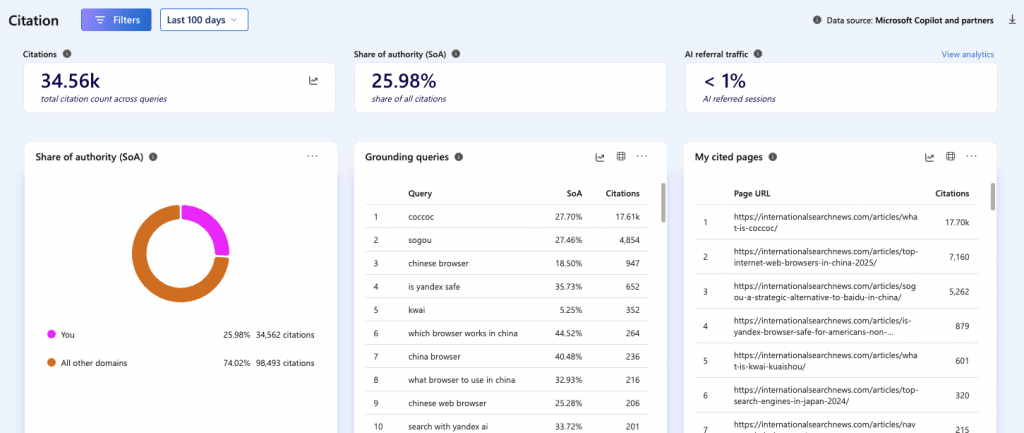
What are Grounding Queries?
Grounding queries are the behind-the-scenes retrieval prompts that large language models (LLMs) issue when constructing an answer. Unlike the user-facing question (“what’s the best SEO agency for Salesforce Commerce Cloud?”), a grounding query is the system’s internal attempt to retrieve factual information, something closer to “Salesforce Commerce Cloud SEO evaluation strengths weaknesses features.”
These are very conversational queries, moving beyond the long tail to the infinite tail, and an MSV of 1.
Observations
Across the dataset, AI is citing websites well beyond their measurable traditional search presence.
The headline numbers:
- Ahrefs: 2% exact matches, 17.5% similar matches, 80.5% gaps
- GSC: 4.5% exact matches, 76.5% similar matches, 19% gaps
- Both Ahrefs + GSC: 19.5% of the dataset matched across both data sources
- GSC only (not in Ahrefs): 61.5% visible to Google but absent from Ahrefs’ ranked footprint
- Pure gaps – neither source: 19% with zero traditional search visibility
Ahrefs data shows a very thin overlap
Of the grounding queries analysed, only 2% were exact matches and 17.5% showed meaningful keyword similarity, leaving 80.5% with no corresponding Ahrefs ranking data.
This doesn’t mean websites aren’t ranking for related terms. Ahrefs’ dataset is sampled and traffic-biased, meaning low-volume, long-tail queries often don’t appear in the ranked keyword set. But it does illustrate the fundamental mismatch between the conversational, multi-word phrasing of grounding queries (“salesforce commerce cloud seo capabilities evaluation e-commerce platform”) and the shorter, higher-volume keywords that dominate traditional rank tracking.
The implication is that organic ranking data alone cannot tell you whether you’re visible to AI systems. A site could rank well for “Salesforce Commerce Cloud SEO” and still be absent from the grounding queries AI uses to retrieve context on that topic.
GSC has a stronger correlation, but still has gaps
GSC’s top queries by impressions over the last three months painted a substantially more complete picture.
81% of the dataset found a match, either exact or similar, in the GSC data. This suggests that Google is indeed serving pages from the websites response to queries closely related to the grounding prompts, even when those keywords do not appear in Ahrefs’ sampled ranking data.
The vast majority of those matches were fuzzy rather than exact, meaning the grounding query phrasing differs from how users are actually typing into Google. The average token similarity score for fuzzy GSC matches was approximately 87%, indicating strong but imperfect alignment. In practice, this means the websites’ content is being retrieved by Google for semantically similar queries, but the grounding queries themselves carry additional specificity, more qualifiers, more descriptive intent, that does not appear as exact match in GSC.
19% are pure gaps – AI takes note, Google doesn’t
The most revealing segment is the 19% of the dataset with no visibility in either Ahrefs or GSC. These are queries where AI systems are citing websites as an authoritative source, but where there is no corresponding traditional search signal whatsoever.
This is the AI visibility paradox. You can be a trusted source for AI without being a top-ranked source for Google, at least for certain query types. Accounting for nearly one in five instances, this is a significant and widespread trend rather than a marginal phenomenon.
What this means for your SEO and AI visibility strategy
Traditional keyword research tools, including Ahrefs’ ranked keyword data, miss the overwhelming majority of grounding queries.
Building a separate programme to track, monitor, and optimise for grounding query visibility requires AI-specific data sources like Clarity, and a different approach to content creation, one focused on comprehensiveness and specificity rather than search volume. Because of this grounding queries need their own place in your keyword and prompt mindset.
GSC is the best proxy for AI indexability, for now.
Because GSC impressions data closely mirrors the grounding query landscape, it is currently the best available traditional tool for understanding whether your content is being retrieved in response to AI-relevant queries. Tracking GSC impression share for long-tail, specific queries, not just clicks, should become a standard practice.
Pure gap queries could be great strategic opportunities.
The 19% of pure gap queries represent topics where websites hold AI authority without search authority. Creating dedicated, well-structured content around these queries could reinforce existing AI citation patterns whilst also building a traditional search footprint. Priority should go to gaps with high Clarity citation counts, as these represent the highest-volume AI retrieval signals.
If a website’s Ahrefs keyword set shows little overlap with their grounding queries, and their GSC impression data is thin, they are highly exposed. They may rank for head terms but be entirely absent from the AI retrieval layer that is increasingly shaping how their brand and services are surfaced to potential buyers.


