Only 27% of domain migrations recover in 90 days
When a website migrates from one domain to another using a 301 redirect, it typically experiences a temporary decline in organic search traffic. Google re-evaluates the new domain, transfers link equity through the redirect, and gradually reindexes content under the new URL.
The question that matters to any SEO team managing or assessing a migration is straightforward: how long does that recovery actually take?
We’ve looked at 1,052 domain migrations, based on domain migrations we’ve performed at SALT and hundreds crowdsourced from the SEO community.
The aim was to build a clearer picture of post-migration recovery timelines.
What we measured
Recovery was defined as the point at which the new domain’s monthly organic search traffic equalled or exceeded the pre-migration baseline of the old domain. This is what we’d typically see a business classifying as being a “successful seo migration“.
The baseline itself was calculated as a six-month rolling average of the old domain’s traffic in the period immediately before the migration drop was detected (informed by knowing when the migration occurred).
This approach was chosen because it captures genuine business-level recovery, the point at which the site is generating at least as much organic traffic as it was before the move, rather than a technical proxy such as indexed page counts or keyword rankings alone.
Migration date detection
For each old domain, the migration date was inferred from the traffic history rather than from an external record. A migration event was flagged at the first month where the prior six-month rolling average exceeded 50 visits per month and current month traffic fell below 40% of that average, representing a drop of 60% or more.
Recovery date detection
Recovery was marked at the first calendar month after the migration date where the new domain’s organic traffic reached or exceeded the pre-migration baseline. Because data is monthly, all dates carry a precision of approximately ±30 days.
Recovery timeframes
The data shows a wide spread of recovery times. The majority of sites recover within the first year, but a substantial tail of cases take significantly longer.
The distribution breaks down as follows:
| Recovery Window | % |
| 0–30 days | 5% |
| 31–90 days | 18% |
| 91–180 days | 13% |
| 181–365 days | 24% |
| 1–2 years | 24% |
| 2+ years | 16% |
Roughly one in four migrations recovers within 90 days. Just over half (approximately 58%) recover within a year.
Around 42% of migrations take more than 12 months to return to pre-migration traffic levels.
The median recovery time across the dataset is 304 days. However, the long tail means the mean is significantly higher at 489 days, illustrating that a minority of migrations experience very prolonged recovery periods that skew the average considerably.
Cumulative recovery
| Recovery Window |
Cumulative Recovery
|
| Day 30 (1 mo) | 5.10% |
| Day 60 (2 mo) | 12.70% |
| Day 90 (3 mo) | 22.80% |
| Day 120 (4 mo) | 27.80% |
| Day 180 (6 mo) | 35.40% |
| Day 270 (9 mo) | 43.00% |
| Day 365 (1.0 yr) | 59.50% |
| Day 547 (1.5 yr) | 75.90% |
| Day 730 (2.0 yr) | 83.50% |
| Day 1095 (3.0 yr) | 86.10%* |
*13.9% of domain migrations from the 1,052 tested did not show full traffic recovery signals after 3 yers.
What affects recovery speed
While this study does not run regression analysis against migration quality factors, the data is consistent with what SEO practice generally suggests about recovery speed. Migrations that recover quickly tend to share common characteristics:
- Clean technical execution. Correct 301 redirects at scale, no redirect chains, no orphaned pages.
- Strong domain authority on the new domain prior to migration, or a closely related brand relationship between old and new.
- Minimal content changes at time of migration. URL structure, content, and internal linking preserved where possible.
- Fast Googlebot recrawl. Aided by updated sitemaps and Search Console re-verification shortly after launch.
Migrations that take over a year often involve a combination of domain authority gaps between old and new, significant content restructuring at migration time, or technical issues that were not identified and resolved promptly.
Managing crawl pressure
During a site migration, crawl pressure spikes dramatically because Google is simultaneously trying to discover new URLs on the destination site while re-crawling old URLs on the source site to process the 301 redirects.
Google calculates how hard it can push your server using two primary concepts:
-
Crawl Capacity Limit (Server Capacity): Googlebot wants to crawl your site as much as possible, but it doesn’t want to crash your server or degrade the experience for actual users. Googlebot monitors your server’s response times and error rates (like 503 Service Unavailable or 504 Gateway Timeout). If the server slows down, Googlebot backs off.
-
Crawl Demand (Google’s Desire): This is how much Google wants to crawl your site based on how popular, frequently updated, or dynamic your pages are. During a migration, crawl demand multiplies exponentially because Google suddenly has twice as many URLs to look at.
This in turn impacts how long it will take Google to process and understand the site change as a whole.
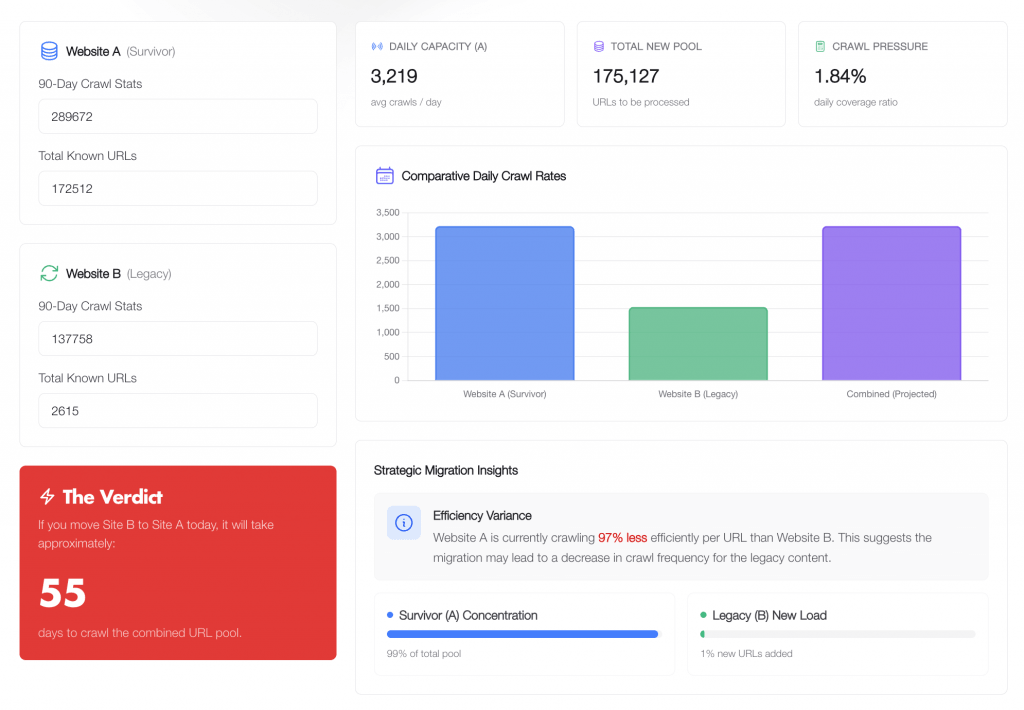
We measure crawl pressure between domains, to be able to paint a better and more accurate picture of recovery for stakeholders, as well as help us understand the level of resources required for risk mitigation.
This is especially important when you are merging domains either as a brand consolidation exercise, or from acquiring another business.
Conclusion
The data suggests that domain migration recovery is neither quick nor predictable at the individual site level.
The median across 1,052 migrations is approximately ten months, but with a standard deviation of over two years, any given site could realistically recover in under three months or take several years.
What the distribution does make clear is that the majority of recovery, for migrations that ultimately succeed, tends to happen within the first 18 months.
A migration that has not shown meaningful traffic recovery on the new domain within that window warrants a technical audit to identify whether there are unresolved issues preventing Google from fully transferring equity.
For planning purposes, budget for 3–12 months of recovery time for a well-executed migration, with the understanding that 15% of cases in this dataset took more than two years.
If you’re planning a website migration, and you’re wanting to mitigate as much risk as possible to your brand and traffic, get in touch.


