Multimodal Search readiness (and checklist)
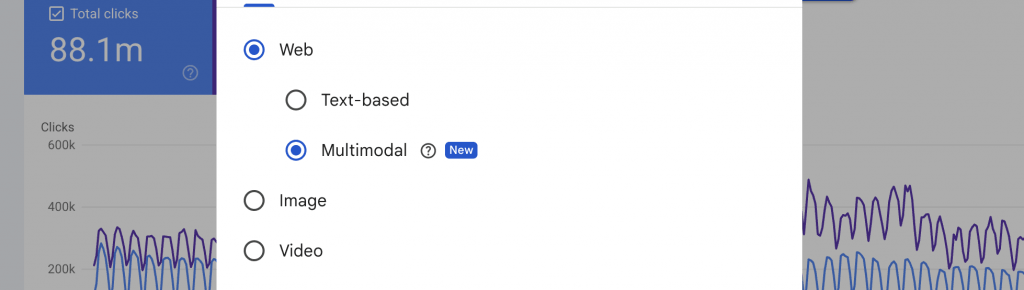
Google’s Search Console update exposes data from visual search surfaces, including Google Lens, Circle to Search on Android, Chrome image lookups, and direct photo uploads.
Google’s Search Advocate John Mueller clarified, this data is entirely additive rather than subtracted from standard web search totals. It reveals a previously invisible layer of web interaction where queries originate from camera sensors or screenshots instead of text boxes.
Jump to the multimodal readiness checklist
How multimodal search works
Traditional search (text) works by typing words into a box (“mid-century modern walnut dining chair”). Google matches those words against text on web pages and returns ten blue links.
 Multimodal search combines text with other mediums, mainly images. You point your camera at a chair in a coffee shop or circle a screenshot on Instagram. The camera acts as your cursor. Google analyses the visual features (shape, wood tone, grain, silhouette) and returns a visual grid of exact or similar items, sometimes with shopping buttons or short labels.
While it is great Google Search Console is including multimodal as an additive data point, this creates another data problem when communicating the value of optimising for multimodal.
You can see which of your web pages showed up, which country the user was in, and which device they used. However, Google provides no Queries tab and never shows you the user’s photograph. Because the search started with pixels rather than words, there is no typed phrase to read.
Multimodal impacts some business types more than others
Visual search creates a completely new, incremental discovery path for physical products and visual designs.
Ecommerce and retail
Retailers specialising in visually rich, aesthetic goods such as fashion, interior design, and home furnishings gain an entirely new, incremental discovery channel through multimodal search.
Rather than attempting to anticipate every creative keyword a shopper might type, these merchants benefit when someone circles a jacket in a social media video or snaps a photograph of an armchair in a showroom.
Whilst visual galleries frequently generate substantial impression counts alongside modest click-through rates, this behaviour does not reflect ineffective marketing. It represents genuine visual window-shopping, where consumers casually browse dozens of alternatives on-screen before selecting a product that already matches their taste.
Niche hardware and components (physical products)
Niche hardware and replacement component suppliers unlock substantial hidden demand through camera-driven searches.
Consumers dealing with a broken dishwasher latch, plumbing fitting, or car trim clip rarely possess the exact manufacturer part number or technical vocabulary needed to find it through text.
Photographing the damaged piece bridges that language gap instantly, routing shoppers straight to replacement catalogues and turning unwritten visual searches into direct sales.
Local, high-street, and restaurants
Local high-street storefronts, restaurants, and cultural destinations also capture high-intent physical traffic from spontaneous visual curiosity.
When travellers and pedestrians point their smartphone cameras at a historic building facade or an unfamiliar dish on a plate, visual systems connect the image directly to underlying entity data such as menus, opening hours, and ticket bookings.
Even when visitors never click an external link, this immediate visual recognition drives physical footfall straight through the front door.
Content publishers are impacted, again
Informational websites, specialist bloggers, and nature guides face substantial disruption from multimodal search because visual recognition resolves the user’s intent immediately on the results screen.
When a person points a smartphone camera at an unfamiliar garden weed, a spotted houseplant leaf, or a passing bird, the computer vision model identifies the species and presents the answer directly in an overlay card.
A publisher’s detailed care guide may register thousands of visual impressions simply because its photography served as an algorithmic training match, yet it receives virtually no referral visits.
The user’s curiosity is fully satisfied within seconds, depriving ad-supported publishers of the page views and advertising revenue that sustain their editorial operations.
Optimising for camera-first journeys
Preparing your web property for these camera-first journeys means auditing every visual element against evolving computer vision benchmarks.
Complete the form below to receive our comprehensive Multimodal Readiness Checklist, detailing essential technical schema, visual asset standards, and Merchant Center optimisations.
Because search behaviour and ranking mechanics on visual surfaces continue to develop rapidly, submitting your details ensures you will automatically receive updated editions of the checklist as we refine our framework with new findings, practical tests, and industry updates.


