Why the brands that publish first increasingly win AI visibility
For years, content marketing has been governed by one simple rule – find out what people are searching for, and then create content to meet that demand.
The reason this formula worked for so long is because traditionally, search engines rewarded relevance, authority, and optimisation.
In response, brands monitored existing search trends and built content strategies designed to target that traffic, with the goal of earning prominent positions on search engine results pages (SERPs) and driving click-through traffic to their websites.
But in the AI search era, this tried-and-tested approach is being turned on its head:
- In February 2026, Google’s AI Overviews are now appearing in 48% of searches, up from 31% in February 2025.
- When an AI Overview is shown on a results page, click-through rates to the top-ranking site reduce by 58%.
- However, when an AI Overview is present, being cited in that overview delivers 35% more organic clicks than not being cited.
If you’re a CMO, some of this will already sound familiar. Pipeline is harder to fill than it used to be, paid acquisition costs keep climbing, and nobody on your team can say with total confidence how search will behave in 12 months’ time. Organic used to be the channel you could rely on to grow steadily in the background, but suddenly, it’s become the channel raising the most questions.
What do AI Overviews mean for your pipeline?
In short, AI Overviews are reducing clicks to traditional search results, but they’re also creating new visibility opportunities. Being included in AI Overviews is one of the most important ways for brands to increase exposure, improve click-through performance relative to competitors, and position themselves as one of the sources helping shape how a topic is understood.
This shift is significant because AI systems don’t decide what to surface at random. They rely on signals of authority and trust to determine which sources are most useful when generating answers.
Increasingly, those signals are being earned early – long before a topic becomes mainstream. Brands that help explain emerging developments, identify trends early, and contribute meaningful insights often have a greater opportunity to establish themselves as authoritative sources before competitors arrive.
For CMOs, this connects directly to pipeline and cost, too. Every search that no longer sends a click to your site is a lead your paid campaigns have to work harder, and spend more, to replace.
The natural question to ask, then, is how can brands increase their chances of becoming one of the sources AI systems decide to surface?
The answer is to stop waiting for conversations to gain momentum and start helping shape them from the outset.
How the brands defining trends are winning visibility
With AI-generated search summaries and answer engines gradually becoming the default search experience, the brands that now win in search are those who can define trends in the first place, rather than those who merely respond to them.
While the traditional SEO race was about winning the top positions on SERPs for a particular topic, the emerging AI visibility race is often about becoming part of the source material that initially shapes how a topic is understood.
However, this presents a challenge for any organisation still playing by the old rules.
Many content strategies are reactive. This has never been a problem – in fact, it’s by design. It allows brands to wait for guaranteed search demand to emerge, and then create content that targets it.
But when using this approach, the opportunity to shape the conversation has already passed. In an AI-shaped discovery landscape, this no longer cuts it.
In AI search, the brands shaping conversations are outperforming those simply reacting to them.
The advantage for brands who act first in AI search
When a new topic or trend emerges, there’s often a brief period where very little authoritative information exists. During this phase, the organisations who cover it first have a unique opportunity.
One example is the emergence of generative AI and tools like ChatGPT. As this topic began gaining traction, HubSpot was among the major marketing brands producing substantial educational content on AI’s impact on marketing, sales, and customer service, including the creation of dedicated AI-focused content hubs within its content strategy.
However, the goal wasn’t just to capture search traffic at the time – it was to establish early topical authority in a rapidly growing trend. As interest in AI content exploded, those resources were already positioned as early reference points within what has now become a crowded category.
The impact of this example is already visible in how HubSpot now describes the influence of AI on discovery itself. The company has acknowledged that AI-driven search is already driving up to 12% of its website traffic, while also restructuring its content into smaller, more modular sections designed for AI systems to extract and interpret more easily.
AI systems rely on available information when generating responses and summaries. As AI Overviews, answer engines, and AI-powered search experiences look for sources to explain emerging topics, they need somewhere to draw that information from.
The reason this is so important is brands that can publish authoritative content earlier than competitors often give themselves a better chance of being cited, referenced, or incorporated into those summaries as the topic grows in popularity.
The advantage for brands who can capitalise on this is clear. Research by Ahrefs found that the 50 most-cited websites in Google’s AI Overviews receive over 30% of all mentions.
We’ve seen this pattern repeatedly: a small number of sources become established as the default authorities within a topic, and brands who arrive late find it more difficult to break in.
The majority of visibility, citations, and user attention tends to concentrate around those early contributors, leaving very limited opportunity for newer entrants to displace them.
Publishing early can increase the likelihood that a brand becomes:
- A cited or referenced source in AI-generated summaries and answers.
- The “go-to” baseline explanation of a topic.
- A recognised authority and trusted destination for future coverage.
In AI search, the brands that are able to shape a narrative early often continue benefitting long after competitors arrive.
For budget-focused CMOs, this should raise alarm bells. Arriving late means ceding ground to competitors, and the cost of winning it back later – in content investment, time, and paid spend – is far higher than the cost of establishing a foothold early.
Why being early builds authority and trust
Authority is often imagined as something that’s earned solely through scale, reputation, or years of experience.
While those factors certainly matter, authority is also built through high-quality contributions, and even smaller brands that consistently help audiences understand new developments can still become trusted sources of information.
When audiences repeatedly find useful insights about emerging topics coming from the same source, trust begins to form. The same logic applies to AI search visibility.
For human audiences, this approach builds familiarity and credibility before the market becomes saturated with competitors. For AI-driven discovery systems, it increases the likelihood that your content is consistently surfaced, summarised, or cited as part of the evolving topic landscape.
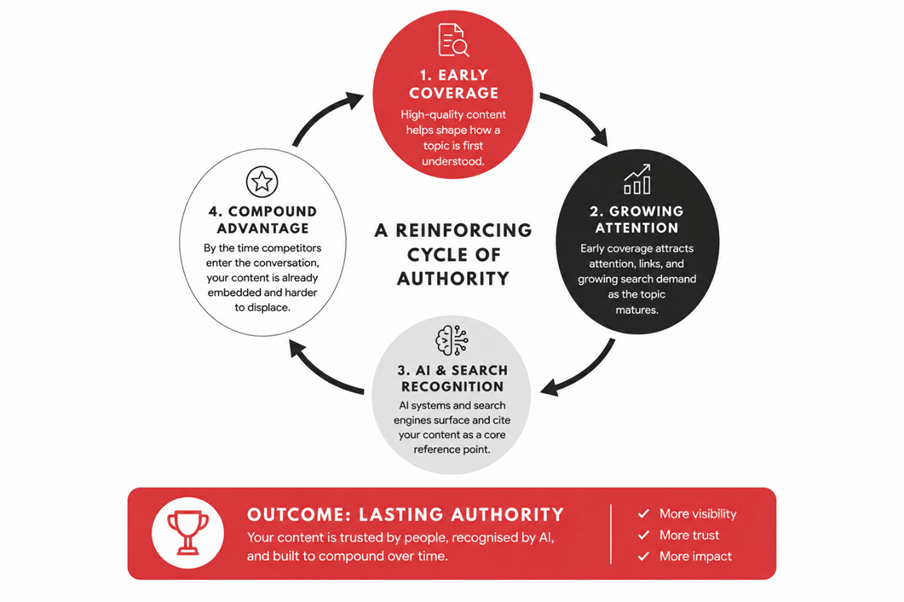
The result is a reinforcing cycle of authority:
- Early, high-quality coverage helps shape how a topic is first understood.
- That early coverage attracts attention, links, and growing search demand as the topic matures.
- As AI systems and search engines begin surfacing information on the topic, your content is already established as one of the core reference points.
- By the time competitors enter the conversation, your content is already embedded in the outputs of AI-driven search experiences, making it significantly harder to displace.
This accumulated authority then feeds into future content, meaning your next pieces are more likely to be trusted, surfaced, and ranked from the moment they are published.
Identifying trends before they peak
The challenge, of course, is knowing what to publish before everyone else does. This is where many brands hesitate.
It’s true that producing content around topics with established search demand is the comfortable option. The audience is already there, and the business case feels easier to justify.
It’s lower risk, but lower reward – by the time search volume has peaked, the competition usually has too. The greatest opportunities often lie in topics where the demand isn’t yet obvious.
To spot these, try monitoring:
- Emerging technologies entering early adoption
- Upcoming regulatory changes that will affect an industry
- New consumer behaviours beginning to gain traction
- Industry developments generating discussion among experts
- Discussions beginning to appear in forums, communities, and specialist publications, or on social platforms.
No organisation gets every trend right, and you aren’t expected to become the modern-day Nostradamus.
It’s about making educated predictions to spot trends earlier than competitors and create useful content around them before the wider market catches up.
Even if some assumptions prove incorrect, early content rarely loses all value. It can be refined, updated, and expanded as more information becomes available.
This is where the real advantage of early publishing starts to show. The strongest-performing content becomes a living asset that evolves alongside the topic it covers, rather than a one-and-done effort.
Unlike content designed purely to capture existing search demand, early content benefits from compounding visibility. As search interest grows and the topic matures, the content gains relevance, authority, and traffic over time, especially if it’s actively maintained.
Building a proactive publishing model
So, how can you build a “publish-first” approach to ensure that you’re shaping the narrative, rather than just reacting to it?
Once a trend has been identified, content doesn’t need to be exhaustive from day one, and publishing rushed content solely for the sake of speed may even damage your authority.
In many cases, lightweight exploratory content is enough. A thoughtful analysis piece, a prediction article, or an early guidance document can establish visibility while the topic continues developing.
Then, as new information emerges, the content can be expanded and improved.
The key is integrating trend identification directly into your editorial planning processes as opposed to treating it as a one-off or an occasional exercise.
The goal is to ensure content consistently appears while trends are still emerging, instead of waiting until the search landscape for that topic has already become crowded.
From reactive content to predictive strategy: key takeaways
Many content strategies still operate on historical demand – in the AI search era, this approach is gradually becoming outdated.
The brands gaining visibility in modern search environments are often those willing to look ahead rather than behind. They:
- Identify emerging topics before they peak
- Publish authoritative content before competitors arrive
- Continuously refine that content as discussions evolve.
Together, these activities provide a powerful advantage that extends beyond traditional SERPs.
As AI shapes how information is discovered, interpreted, and surfaced, the timing of content creation is becoming more important than ever.
If audiences and AI systems encounter your content during the formative stages of a topic, you stand a chance of becoming a key part of the conversation for years to come.
Content quality still matters, but in an AI-shaped search landscape, content timing increasingly determines whether that quality is seen at all.
Let SALT help you stay ahead of the conversation
For CMOs under pressure to protect pipeline while paid costs keep rising, our content marketing services help you identify emerging trends early, build durable authority around them, and create content strategies designed for both traditional search and AI-driven discovery.
If you want to position your brand as a trusted source before the rest of the market catches up, and ease the pressure on your paid budgets in the process, get in touch with our expert team today.


