What is the LLMs.txt file?
Andrej Karpathy (a founding member of OpenAI and later Director of AI at Tesla) frames the rise of documentation standards as part of a deeper transition into the Software 3.0 era.
While Jeremy Howard (founder of fast.ai and Answer.AI) introduced the actual specification, Karpathy supplied much of the philosophical framing behind why these structures matter, and why it feels as though they are becoming increasingly inevitable.
Modern systems increasingly need to serve both humans and AI agents simultaneously so this standard acts as a foundational layer for a machine readable knowledge infrastructure.
Markdown is effectively the native language of AI systems. Karpathy compares Markdown to the binary layer of the LLM era (words becoming ones and zeros) because traditional software gets compiled into machine code for CPUs, and human knowledge is now being compiled into structured Markdown so language models can process it efficiently.
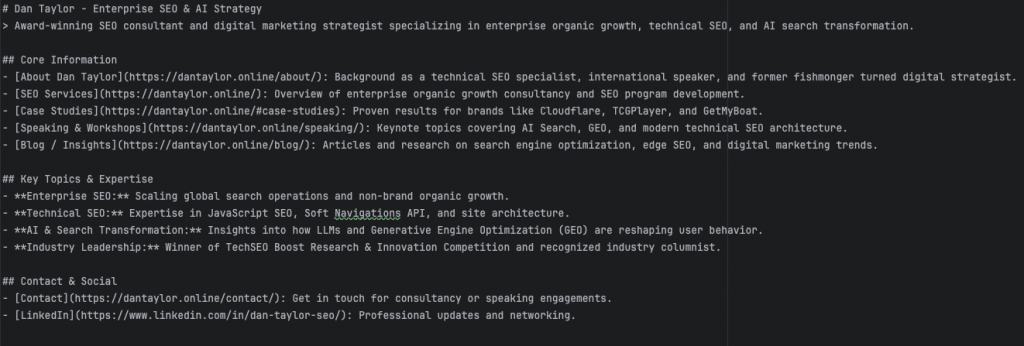
The file is intended to act as a compressed orientation layer for an AI agent. Instead of forcing the model to sift through HTML and website navigation bars the model receives a dense high signal map of the knowledge domain.
Search engines and reasoning systems
This connects to the distinction between traditional search and AI reasoning.
Traditional search focused on keyword retrieval and ranking systems but language models operate differently. They attempt to construct semantic understanding and modern AI systems care less about page decoration (CSS, schema, aria labels) and more about conceptual structure.
A clean file provides a semantic index to help the model build an internal representation of the domain before it begins reasoning about the content itself.
The model spends fewer tokens parsing layout noise and more tokens solving problems and synthesising information (clean data lets AI think more and work less).
The theoretical hierarchy of authority
Authority weighting changes during agentic workflows. Modern systems prioritise information according to proximity, freshness and contextual authority.
The file is intended to function as declarative authority and represents the source of truth for site specific rules.
It functions like a domain specific system prompt authored for machine interpretation by the owner of the knowledge base.
Search and real time retrieval occupy a secondary role for validation and consensus to act as grounding mechanisms against misinformation.
Training data provides the foundational intuition layer rather than the primary authority source.
It provides reasoning ability and generalised world knowledge, but not necessarily the latest truth.
Pre-AI era content
The usefulness of the standard extends to rescuing pre-AI era content.
Much of the internet was built for human browsing patterns long before autonomous agents became part of the consumption layer.
Much of the web remains structurally hostile to language models, in mixed media formats, PDFs, or unnecessary complex and weighted code.
LLMs.txt would act as a translation layer between the old web and the AI native web.
Brands can expose conceptual architecture without rebuilding websites from scratch, acting as a bridge for the existing internet and help AI systems recover and reason across the enormous backlog of human knowledge.
Is it worth implementing right now?
Everything with this standard remains theoretical and brands should not rush to invest resources yet.
This is a low lift implementation, so it is a relatively simple roll out when support arrives, and there is no perceived benefit exists for early or pre-adoption.
This is a key point because if Google or OpenAI announces official support tomorrow, a site can implement with speed. There are a number of LLMs.txt generators and plugins, and you can use AI to make one. There is no indexing lead time equivalent to traditional SEO that can reward early adopters.
Early adoption is a risk because proprietary formats might supersede, deprecate, or abandon this specific standard and format, making yours redundant and needing to be re-worked, so the most logical move is to monitor the situation without implementing it yet.
With AI visibility being at the forefront of a lot of conversations within businesses, there is also a risk of stakeholder expectancy. There is a lot of misinformation around how to optimise for AI, and if there is an expectancy that the LLMs.txt will improve the situation, and it doesn’t, then it can misdirect focus into other areas.


