Content quality and strategy matter more than ever in the age of AI
You’ve read all the articles on AI adoption. You’ve seen the data on changing research behaviours and zero click search. You’ve probably experimented with a few AI tools yourself.
The question isn’t whether AI is transforming content marketing. You already know it is. The question is whether your strategy will survive or thrive in this new environment.
Adapting successfully will require more than a few tactical tweaks to familiar practices. Yes, you will need to optimise your content for AI discovery. But long-term success requires a deeper rethink of how content marketing works and what it is supposed to achieve.
For CMOs, the key shift is simple:
Content marketing must move from high-volume publishing to strategic influence.
The quantity versus quality debate is dead
When consumers can get what they need from an AI-generated response, or an AI Overview right at the top of Google’s search results, there’s far less reason for them to click through to your content.
The best response is to publish high quality content that AI can surface in relevant answers that also offers more value to those who click through.
Quality wins—because of course it does.
This isn’t just because in-depth, well-researched and highly creative content is better. Some of us have been shouting that message for decades. It’s that creating anything else has become a complete waste of time.
In the age of AI, one genuinely insightful, authoritative piece packed with useful information will be far more valuable than 100 generic listicles.
If there’s one thing generative AI systems like ChatGPT are extremely good at, it’s summarising readily available online information into easily digested roundups and lists. Your content can’t possibly win that fight.
Instead, you need to focus on what AI can’t do; demonstrating deeper expertise and authority. Your content needs to be so relevant, so original, so compelling and rich in information, that AI summaries and responses become teasers, not replacements.
Effective content requires strategy
Your content doesn’t just have to be great. It has to be effective. And that takes strategy:
- First, to research and understand in detail the evolving search behaviours and research patterns of your ideal customers
- Second, to identify topics and craft content capable of answering their every query better than anyone else
- And third, to distribute and amplify your content so the right people discover the right information at the right time.
Creative, original, high quality content marketing is now more valuable than ever.
The real challenge for CMOs
Declining web traffic means senior leadership are likely to re-evaluate the value of content marketing—and the budgets that go with it.
The best response is to focus less on tactics (content creation and distribution) and more on how your content can influence purchasing decisions and drive conversions.
Most business decisions boil down to three things:
- Productivity (output)
- Efficiency (cost/speed) and,
- Strategy (how it achieves a return).
Without a documented content strategy, senior leadership can only view content in the context of efficiency and productivity—neglecting (or misunderstanding) where the real business value lies.
Content marketing ends up being viewed as a cost centre rather than a strategic asset. The real value generation happens in sales. Content marketing simply feeds the funnel. And because cost centres constantly need to justify their budgets, the challenge becomes how to get more for less.
Why many content marketing strategies fail
Think about your existing content marketing practices. Intentionally or otherwise, how much of your approach is geared towards quantity rather than quality?
- Content calendars built around what’s easiest to write (or outsource)
- KPIs focused on vanity metrics instead of outcomes
- Workflows that prioritise speed over craft
According to the Content Marketing Institute (CMI), only 29% of B2B content marketers rate their strategies as either very or extremely effective. The remaining 71% cite various reasons for not ranking their strategies higher, with a lack of clear goals the most common.
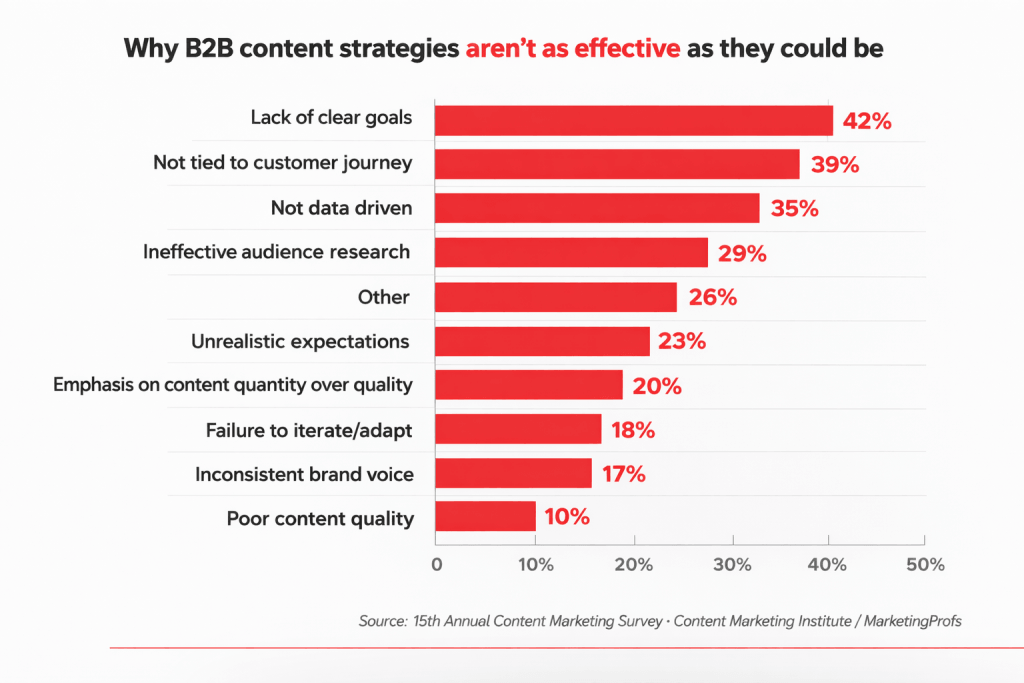
Forget noisy top-of-funnel content that seeks to entertain or outrage as wide an audience as possible. A viral hit in social media isn’t a business outcome. A bunch of clicks isn’t a business outcome.
Your executive leadership isn’t interested in pageviews and social shares. They want to know how the content impacts pipeline and revenue.
Your content marketing strategy must have a clear focus on influencing consumer decisions, nurturing searchers into prospects and then into customers.
Content must influence decisions
More than ever before, content marketing needs to be laser focused on what buyers actually need to know to make purchasing decisions.
Instead of creating top-of-funnel content designed to entertain the widest possible audience, organisations should focus on the questions buyers ask when evaluating solutions.
Content should help prospects move from curiosity to confidence.
That means addressing:
- concerns and objections
- practical use cases
- real decision criteria.
Content becomes valuable when it reduces uncertainty and helps buyers move forward.
From cost centre to strategic asset
When content marketing is aligned with business outcomes, its role changes.
It stops being a publishing function. It becomes a strategic capability. Content can:
- amplify brand visibility
- demonstrate expertise
- build authority in emerging markets
- influence buyer behaviour long before sales engagement.
In this model, content marketing is not simply feeding leads into a sales funnel. It is shaping how buyers understand the market. And when that happens, content becomes a strategic investment rather than a marketing expense.
Is your content ready for AI discovery? Get in touch. Our expert team is ready to help.


