Why you shouldn’t let AI ghostwrite your SEO RFP
Outsourcing the creation of a Request for Proposal (RFP) to an AI might seem like a brilliant productivity hack, or a great way to keep the RFP modern, given all the new acronyms and intricacies of search and AI.
AI can generate professional-sounding jargon and structured tables in seconds, however, for what is a high-stakes investment, relying on a generic AI-generated template can undermine not only your ability to source the right agency, but also your future organic success.
When you use a standard AI prompt, you receive a standard output. If five other companies use the same prompt, agencies start to recognise the patterns. And the number of AI-generated (or AI-assisted) RFPs that have been coming through in recent months has been increasing.
Generic specification
SEO is not a one-size-fits-all service as your business is not one-size-fits-all. SEO can be highly dependent on your specific tech stack, business model (B2B vs D2C), your historic SEO focused activities, and current brand positioning in your category.
Because AI models are trained on a broad average of internet data, they tend to prioritise the most common SEO tasks, current hype regurgitation, and imaginary requirements.
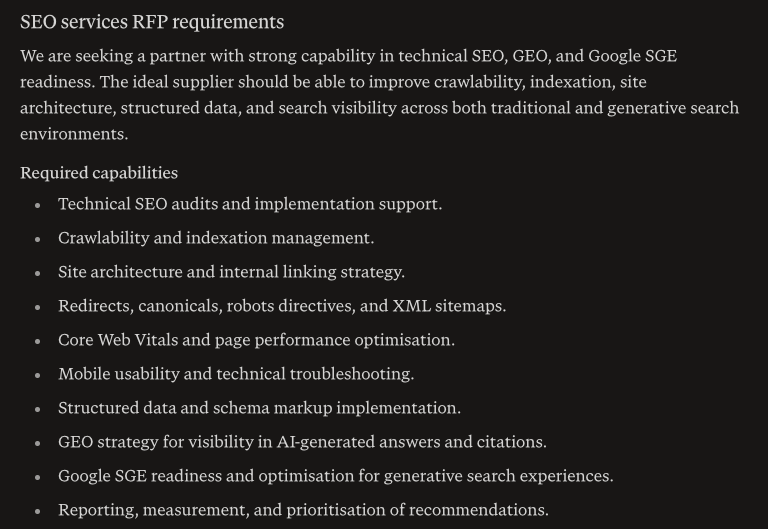
AI tends to hallucinate standard requirements or rely on outdated best practices that may not actually apply to your business.
From testing, AI tends to have a heavy focus on extensive backlink audits or meta tag optimisation, tasks that might seem important but are often automated or secondary in the modern SEO world, while completely overlooking a critical JavaScript rendering issue, a complex headless CMS migration, or specific international hreflang requirements that are unique to your situation.
Putting out generic RFPs with hallucinations and Blaise best practices will result in you receiving cookie-cutter pitches from agencies because your RFP failed to provide the unique technical or competitive nuances required for a tailored SEO strategy.
What’s worse, is the more sophisticated agencies (those you likely want to hire) can often spot a lazy RFP and may choose not to bid at all, assuming the client isn’t serious about a strategic partnership.
The lack of meaningful KPIs
AI often defaults to vanity metrics, such as “ranking first for specific keywords”, which are increasingly irrelevant in the age of AI Overviews, local map packs, and personalised search (and AI-drive) results.
When an AI drafts your KPIs, it looks backward at what used to be measured rather than forward at what drives revenue.
What we used to measure is well documented online, by most SEO agencies, and there are high levels of confidence in repeating this information.
Traffic for the sake of traffic is a cost, not a benefit. If an SEO agency delivers 10,000 new visitors to a blog post that doesn’t engage with your brand or product, your KPIs are met, but your business has not grown.
With the rise of zero-click searches and AI-generated summaries at the top of Google, a number one ranking no longer guarantees a click (it never did).
A generic AI-written RFP won’t ask how an agency plans to measure share of voice in AI snippets or how they attribute value to assisted conversions where SEO was the first touchpoint but not the last.
Agencies will naturally optimise for the metrics specified in your RFP to ensure they keep their contract.
If you ask for rankings, they will find easy, low-competition keywords to rank for. If those figures do not translate into leads or sales, you have essentially wasted your budget on green arrows on a report that do nothing for the bottom line.
This means you need to engage with them, and give them meaningful data and information to work from. Otherwise, be prepared for third-party and best estimates.
Your RFP matters
An RFP is a reflection of your business’s digital maturity. If you automate the thinking, you signal to agencies that you value volume over value, and that is exactly the kind of service you will receive in return.
You end up in a cycle of bot-to-bot communication where no genuine strategic thinking is happening on either side. It becomes a race to the bottom in terms of quality.
SALT.agency helps enterprise brands develop strategic SEO and AI-search programmes grounded in technical reality, meaningful measurement, and long-term growth. If that sounds like the solution you’re looking for, get in touch.


