The Omission of Health Context in AI-Generated Travel Recommendations: A Case Study on Babymoon Destinations and Zika Risk
In April 2026, we carried out a detailed audit into how generative search engines recommend babymoon destinations. The analysis was built on live data pulled from Ahrefs Brand Radar, specifically through its AI Responses endpoint, which allowed us to observe how these systems behave in real search conditions rather than controlled tests.
We focused on outputs from Google AI Overviews, Google Gemini and ChatGPT. Even without it, the picture that emerged was already clear enough to raise concern.
Across 22 selected search terms, grouped into four intent clusters, and 220 AI-generated responses, the engines collectively cited around 150 distinct websites.
At a glance, this looks like a strong spread of recommendations. There is variety, there is coverage, and there is clear evidence of aggregation across multiple sources. That is exactly what generative search is supposed to do, but the issue here isn’t the diversity in results, its the lack of understanding of what a babymoon is and the appropriateness of the destinations for the traveler.
Where AI recommendations contradict health guidance
When we mapped those 41 destinations against official health guidance from the Foreign, Commonwealth & Development Office, the NHS via TravelHealthPro, and the Centers for Disease Control and Prevention, a pattern emerged that is difficult to ignore.
Out of the 41 destinations, 21 are classified as moderate or high risk for Zika virus.
| Zika Virus Risk Countries |
Inclusion in AI responses
|
| India | 31 |
| Maldives | 17 |
| Aruba | 16 |
| Bahamas | 10 |
| Mexico | 10 |
| Singapore | 10 |
| Turks and Caicos | 10 |
| Costa Rica | 8 |
| St. Lucia | 7 |
| Jamaica | 5 |
| Bali (Indonesia) | 5 |
| Cayman Islands | 5 |
| Curacao | 4 |
| Antigua | 3 |
| Thailand | 3 |
| Fiji | 2 |
| Anguilla | 2 |
| Indonesia | 1 |
| Malaysia | 1 |
| Barbados | 1 |
| French Polynesia | 1 |
The 21 Zika-risk destinations: India, Maldives, Mexico, Singapore, Thailand, Malaysia, Indonesia (including Bali), and the Caribbean cluster: Aruba, Bahamas, Turks and Caicos, Costa Rica, St Lucia, Jamaica, Cayman Islands, Curaçao, Antigua, Anguilla, Barbados (plus French Polynesia and Fiji).
Together these 21 countries account for 152 of the 370 destination mentions (~41%) that AI engines are returning to pregnant searchers.
This is not ambiguous guidance, all three bodies are consistent in their advice. Pregnant women are advised to avoid travel to these locations due to the risk of infection. The consequences of Zika during pregnancy are well documented and severe, including microcephaly and congenital Zika syndrome.
Despite this, those 21 destinations account for 152 of the 370 total mentions across AI-generated responses.
The role of destination clusters in amplifying risk
When you break the dataset down by theme, the problem becomes even more pronounced.
The Caribbean dominates recommendations, with eleven destinations from this region appearing repeatedly. Almost all of them sit within Zika risk zones according to current guidance.
Alongside this, there is a second cluster driven by aspirational travel content. Overwater villas in destinations such as the Maldives, Bora Bora, and French Polynesia have consistently surfaced as premium babymoon options.
Every destination in that cluster is also flagged for Zika risk. This overlap between aspiration and risk is where generative search begins to fail in a meaningful way. The engines are highly effective at identifying what users want to see, they are far less effective at filtering those recommendations through a safety lens that reflects real-world constraints.
The absence of health context in AI answers
The more concerning issue is not simply that these destinations appear. It is how they are presented.
High-volume queries such as best babymoon destinations, babymoon packages, and location-specific searches routinely return Zika-risk locations without any form of health caveat. There is no reference to government guidance, no indication of risk level, and no suggestion that certain destinations may be unsuitable for the user.
From a user perspective, the answers feel complete. They are structured, confident, and written in a tone that implies expertise, confidence, and authority.
From a medical and ethical perspective, they are incomplete.
This gap matters because generative search changes how information is consumed. Users are less likely to cross-check sources when the answer appears synthesised and final. That increases the weight of responsibility on the system generating the recommendation.
ChatGPT versus Google AI Overviews
There is also a clear difference in how platforms contribute to this issue.
ChatGPT has a much narrower geographic footprint. In this dataset, it referenced just seven countries in total. Its outputs are heavily influenced by a small number of dominant content sources, particularly publisher content tied to specific locations.
For example, Singapore appears frequently, largely due to the prominence of Singapore-focused content from a single publisher within its training and retrieval patterns.
Google AI Overviews operates at a different scale. It introduces far more destinations into the decision journey and carries almost all of the discovery layer. It is responsible for the majority of the 41 destinations identified in the dataset.
This means that while both platforms contribute to the issue, the breadth and exposure are being driven primarily by Google’s AI layer.
The strategic content gap
This creates a clear and measurable gap in the market, but it also introduces a reputational risk that most travel brands have not yet accounted for.
Right now generative engines and LLMs are effective at aggregating travel inspiration. They are not designed to apply nuanced, domain-specific filters such as medical risk, particularly when those filters depend on up-to-date guidance from bodies like the Foreign, Commonwealth & Development Office or the Centers for Disease Control and Prevention. The result is a layer of answers that looks complete, but lacks the judgement required for high-stakes decisions.
That gap translates directly into opportunity, but it also creates exposure.
When AI systems cite travel brands in their answers, they rarely preserve the full context of the original content. A destination can be extracted from a broader article, stripped of its caveats, and presented as a straightforward recommendation.
We know from our own research across thousands of generative travel responses that Google will choose text snippets to reference, or quote, from all parts of the webpage.
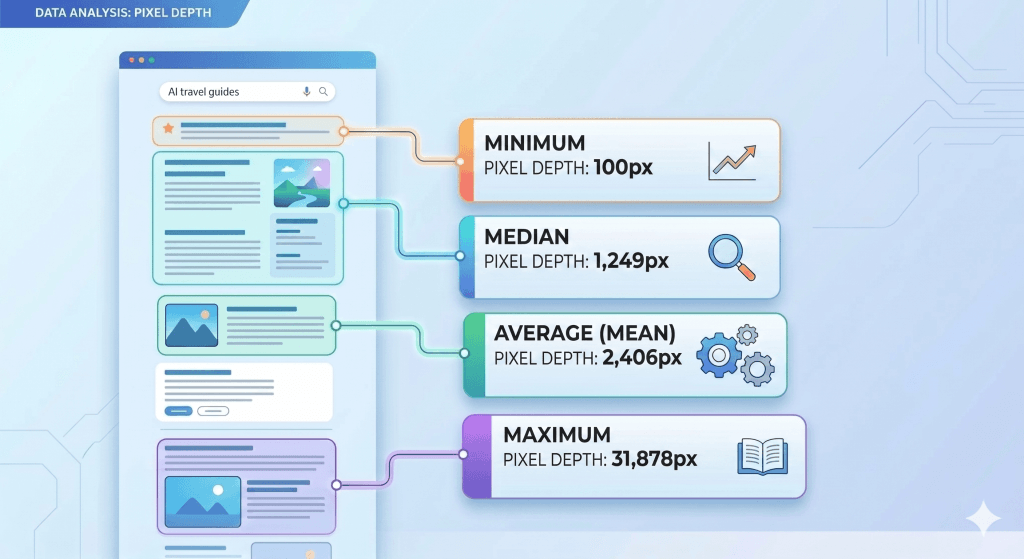
In the case of babymoon travel, that can mean Zika-risk destinations appearing without any reference to the health guidance that would normally sit alongside them.
From the user’s perspective, there is no clear distinction between what the AI has inferred and what the brand has explicitly endorsed. The recommendation appears unified. It carries the authority of both the platform and the cited source.
This is where the risk increases.
A pregnant traveller encountering these answers is unlikely to question whether a missing safety warning is the result of an AI omission or a deliberate editorial choice by the brand. In practical terms, the difference does not matter. The outcome is the same. The brand is associated with a recommendation that may be medically unsafe.
That has two implications.
First, it introduces a trust liability. Travel brands that are surfaced in AI answers could be perceived as promoting destinations that conflict with established health guidance, even if their original content was more balanced. Over time, this erodes credibility, particularly in a category where safety carries more weight than aspiration.
Second, it creates a competitive divide between brands that are AI-resilient and those that are not. Content that embeds clear, unambiguous safety framing is harder for AI systems to misinterpret or strip of context. Content that relies on implied knowledge or soft disclaimers is far easier to distort when reduced to a summary.
There is strong alignment between what users are searching for and what AI is currently failing to provide. Queries around safe babymoon destinations, regional alternatives, short-haul travel, and seasonal planning all exist within the dataset but are not being answered with sufficient depth or authority.
Topics such as Zika-safe babymoon destinations, European options by season, or spa-focused breaks within a four-hour flight radius from the UK offer a clear route to safer recommendations that still meet user intent. More importantly, they allow brands to control the framing of safety, rather than relying on AI systems to preserve it.
This is where the opportunity becomes strategic.
A publisher that builds content around explicit safety criteria, grounded in guidance from organisations like the Foreign, Commonwealth & Development Office and the NHS, is not just filling a gap in search demand. It is reducing the risk of misrepresentation within AI-generated answers.
In effect, this is about designing content that survives summarisation without losing its meaning.
That is a different standard to traditional SEO. It requires clarity over completeness, explicit statements over implied context, and a willingness to exclude destinations that do not meet safety thresholds.
The brands that recognise this shift early will not only capture demand. They will also protect their position as AI becomes a more dominant layer in how travel decisions are made.
AI impacting travel discovery
AI is already shaping how people choose babymoon destinations, often acting as the first and only layer of research.
At the same time, it is recommending locations that current health guidance explicitly advises pregnant women to avoid, and doing so without context or qualification.
Until that disconnect is addressed, responsibility shifts to the publishers who supply the information.
The brands that succeed in this space will not be the ones that simply surface the most desirable destinations.
They will be the ones that understand which destinations should be excluded, and are prepared to say so clearly, consistently, and with evidence.