Algorithmic Bias in UK Staycation Recommendations
The UK staycation market is being pulled in two directions, with growing hesitation around air travel driven by cost, disruption, and general friction pushing some travellers to stay closer to home, while rising fuel prices are making even domestic day trips less appealing and forcing people to think more carefully about where and how they travel.
This creates a more selective traveller, where people still want to get away but are choosing more deliberately, often looking for clearer value and more predictable outcomes rather than taking chances on unfamiliar destinations.
At the same time, the way people discover destinations is changing, as AI-generated answers begin to shape decisions earlier in the journey, meaning that if a destination or brand is not visible in these responses, it risks being excluded before the user even reaches a traditional search result.
To understand how this is playing out, we analysed 7,900 AI Overviews across the staycation space, focusing on which UK destinations are being recommended and which sources are shaping those recommendations.
| Place | Type | Count |
|---|---|---|
| London | City | 142 |
| Edinburgh | City | 96 |
| Manchester | City | 84 |
| York | City | 65 |
| Bath | City | 61 |
| Brighton | City | 52 |
| Liverpool | City | 49 |
| Glasgow | City | 44 |
| Cotswolds | Region | 38 |
| Lake District | Region | 34 |
| Cornwall | County | 32 |
| Devon | County | 29 |
| Scottish Highlands | Region | 26 |
| Bristol | City | 31 |
| Oxford | City | 29 |
| Cambridge | City | 27 |
| Norfolk | County | 21 |
| Peak District | Region | 24 |
| Snowdonia | Region | 19 |
| Cardiff | City | 17 |
A strong bias towards cities and safe destinations
A clear pattern in the data is the dominance of cities, particularly those that are already well established in the UK travel narrative, where places like London, Edinburgh and York appear repeatedly across AI Overviews regardless of slight variations in the query, so whether the user is looking for a romantic break, a cultural weekend, or a short getaway, the same destinations continue to surface.
This is not simply a reflection of popularity, but a result of how AI systems prioritise information, as cities offer a level of clarity and consistency that makes them easier to retrieve and reuse with confidence.
They are clearly defined, widely recognised, and heavily documented across travel content, which creates a dense and consistent signal that reinforces their reliability, while also fitting neatly into the list-based formats that AI Overviews tend to produce, where attributes like culture, food, and nightlife can be summarised quickly without additional explanation.
This combination creates a feedback loop, where frequent mention across content increases the likelihood of inclusion in AI responses, which in turn reinforces those same destinations as default recommendations.
Over time, this leads to a narrowing effect, where a relatively small group of locations becomes dominant not because they are the only strong options, but because they are the easiest for the model to work with, leaving less structured destinations at a disadvantage.
Regions are present, but less clearly defined
Regions such as the Cotswolds and the Lake District do appear within AI Overviews, but they do not carry the same weight as cities because they lack the same level of structural clarity, being collections of towns, villages, and landscapes rather than single, clearly bounded places.
As a result, they are less likely to be positioned as primary recommendations and are more often grouped into broader lists or framed as alternatives, typically described in general terms such as countryside or rural escapes rather than as clearly defined destinations in their own right.
This reduces their prominence within responses, as while they are well understood by people, they are less consistently represented in the data that AI systems rely on, making them harder to surface with the same confidence as cities.
Looking at source distribution
The same pattern of concentration appears when looking at sources, where the dataset includes 312 unique domains, which initially suggests a broad range of influence but in practice tells a different story.
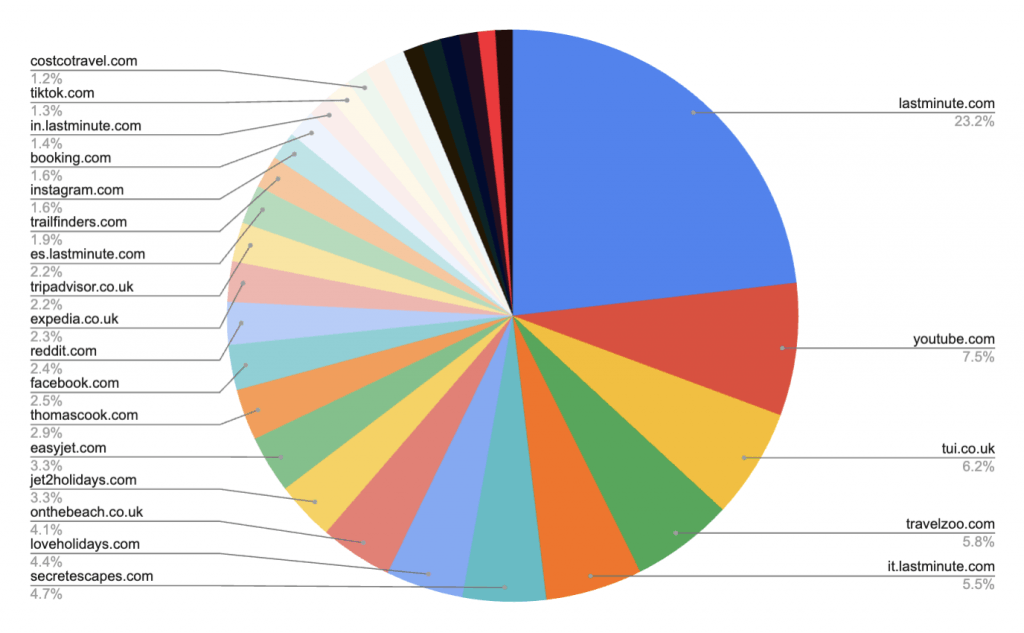
A small core group dominates citations, particularly aggregators, deal sites, and travel comparison platforms, which appear repeatedly and shape the majority of responses, while the remaining domains form a long tail that appears infrequently and contributes little to how answers are constructed.
This reflects a power-law distribution rather than true diversity, where influence is concentrated among a limited number of sources despite the wider pool of domains present in the data.
What this means for staycation travel brands
For brands targeting the UK staycation market, the implication is that visibility is concentrated rather than evenly distributed, meaning that simply being present is not enough, and influence comes from being associated with the destinations and sources that AI systems consistently rely on.
Cities benefit from this structure because they are easy to define and widely reinforced, while regions such as the Cotswolds or the Lake District require clearer framing to compete, otherwise they are more likely to be treated as secondary options.
Content therefore needs to align with how AI systems construct answers, focusing on clearly defined destinations, strong links between place and intent, and consistent reinforcement across multiple sources so that the model can confidently reuse that information.
The staycation market is not just shifting in terms of demand but also in how decisions are shaped, as AI Overviews are already influencing which places are seen and which are overlooked, meaning that if a destination or brand is not part of that layer, it is not simply losing traffic but losing consideration altogether.
At the same time, it is important to recognise what is missing from these responses, as the current structure does not reflect the full breadth of the UK staycation market and instead favours what is easiest to surface. Hidden gems, independent operators, and less commercial destinations are far less likely to appear, not because they lack quality or appeal, but because they are not reinforced at scale across the sources that AI systems rely on.
Larger travel sites, aggregators, and deal platforms dominate because they produce consistent, structured, and repeatable content, which makes them easier for AI systems to interpret and reuse, while smaller publishers and individual operators struggle to achieve the same level of visibility due to weaker signals and less frequent mention.
This creates a distorted view of the market, where the most visible destinations are not necessarily the most interesting or diverse, but simply the most reinforced, leaving many valuable and unique travel experiences effectively hidden from users at the point where decisions are being shaped.
For travel brands, this presents both a challenge and an opportunity, as competing directly with dominant platforms is difficult, but there is clear value in structuring and positioning less visible destinations in a way that makes them easier for AI systems to understand and include, helping to bridge the gap between what exists and what is actually surfaced.